Heather D. Ward
Independent Scholar
nisaa@bellydancewithnisaa.com
Abstract: For generations, the ghawāzī of Egypt have been a source of fascination for Egyptians and non-Egyptians alike, yet confusion persists regarding the realities of their identities and histories. This article provides an overview of the complex history of the ghawāzī based on currently available research, and examines the discourse around their ethnic affiliations. In posing the question, who are the ghawāzī, the author interrogates current popular and scholarly understandings of these women and attempts to re-center the conversation on ghawāzī perspectives.
Keywords: ghawāzī, identity, marginality, Gypsy, Banū Sāsān/Ghurabā’
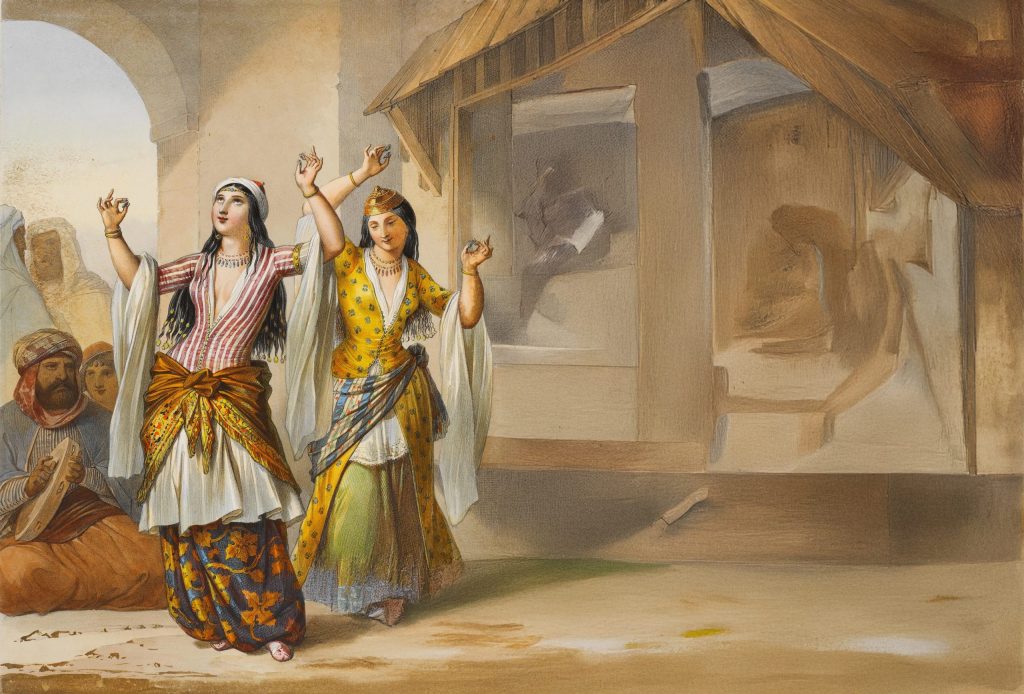
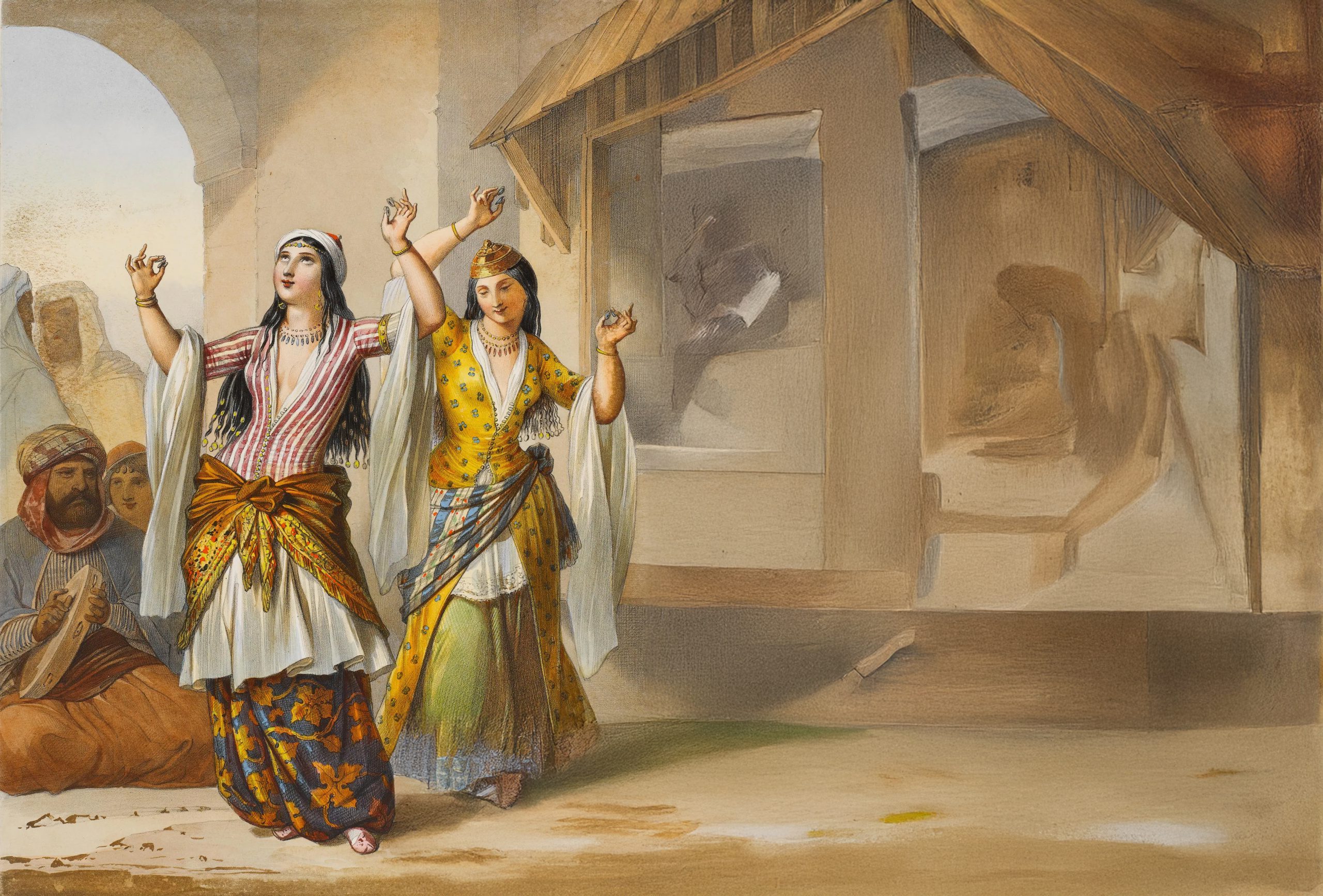
Who are the ghawāzī? Any attempt to answer this seemingly simple question lays bare the complexity of their history and their fraught position in Egyptian society. Generally speaking, the ghawāzī are a class of female professional entertainers and practitioners of a form of dance commonly rendered as “belly dance” in English. Yet the precise definition of who constitutes this class, and where and for whom they perform, has changed tremendously over time. Adding to this complexity, the ethnic identity of these women remains a subject of debate: academic researchers, dance aficionados, and ordinary Egyptians continue to disagree on whether these women really are “Egyptian” or not – often with little regard for what the ghawāzī themselves have to say about their own identities.
So, who are the ghawāzī? Let us begin by unpacking the term. Ghawāzī is the plural form of ghāziyah, which is the feminine form of the noun ghāzī, meaning “raider” or “invader.” Ghāzī was used to refer to a warrior who engaged in military campaigns in the name of Islam; this term became a common honorific in the Ottoman era. Su’ād Māzin, the eldest sister of the famous Banāt Māzin ghawāzī of Luxor, offered a poetic interpretation of the term ghāziyah: “They call us by the name ghāziyah. To them, it’s a dirty word. But to us, it means that we invade their hearts with our dance and in any other way they want” (Marre, 1992). Nearing (2004) has suggested a more mundane origin: the term ghawāzī may actually derive from a specific type of Ottoman-era coin nicknamed a ghāzī. These coins were imprinted with the names and titles of Ottoman Sultans, many of whom assumed the honorific ghāzī. Coins of this sort were used to tip a dancer by licking the coin and sticking it to the dancer’s forehead or body. This usage of the ghāzī coin is mentioned by the French author Gérard de Nerval (1884, pp. 88-89). This tipping practice is also noted by both Clot-Bey and Lane, though neither offers a specific name for the coins (Clot-Bey, 1840, p. 94; Lane, 2005, p. 495).
To date, I have not encountered the term ghawāzī in reference to female professional entertainers prior to the Ottoman period, though there were female performers who fulfilled the same social role as the ghawāzī in earlier times (see Ward, 2024 for a detailed history). Since it seems that ghāzī coins were not minted prior to the Ottoman era, the idea that the term ghawāzī as a designation for these women emerged due to the practice of tipping with these coins is compelling. Nevertheless, the original connotation of the term ghāzī as “invader” has prompted many to assume that the ghawāzī are not indigenous to Egypt, an issue I will return to later.
Prior to the mid-nineteenth century, the ghawāzī were known as popular entertainers who performed for the Egyptian masses (Chabrol, 1826, pp. 119-120; Jomard, 1829, p. 441; Savary, 1785, pp. 155-156; Villoteau, 1826, pp. 170-171). In this regard, the ghawāzī were distinguished from their counterparts, the ‘awālim, who generally performed for an elite clientele. They also differed in where they performed: whereas the ‘awālim usually performed in the privacy of the ḥarīm of the homes in which they were hired, the ghawāzī frequently danced and sang in public spaces for mixed-gender or male audiences. The primary performance contexts of the ghawāzī were public markets and festivals, particularly mawālid (saint’s day festivals), and celebrations of birth or marriage among lower-class Egyptians. In addition to these settings, the ghawāzī could be found performing within or in front of Egyptian coffee houses (Fraser, 2015, pp. 76-78). Unlike the ‘awālim, the ghawāzī were rarely invited to perform in the homes of the well-to-do. Further, Muslim families were far less likely to invite the ghawāzī into their homes than Europeans and non-Muslim Egyptians (Clot-Bey, 1840, pp. 90-91).
Still, it is important to bear in mind that the boundary between the ‘awālim and the ghawāzī was more permeable than it was described in many Western sources of the time. For example, Isabella Romer (1846, p. 127) observed with dismay that the Turkish daughter of the last Dey of Algiers, a member of Cairene high society, had accepted a ghāziyah into her household: “She was formerly one of the public ghawazee of Cairo, but her performance possessed so many charms for the Dey’s daughter that she took her into her household, and has loaded her with jewels, and pays no visits without being accompanied by her.”
In the 1830s, government action against “public women” would have profound implications for the historical trajectory of the ghawāzī. Early in the decade, Muḥammad ‘Alī Bāshā banned all public dance performances by female professional entertainers in Cairo and Alexandria (Clot-Bey, 1840, p. 90; Lane, 1860, p. 377; Lane, 2005, p. 566). The same decree also banned prostitution in Egypt’s urban centers. Punishments for violating the law were severe. Lane writes (2005, p. 566): “Women detected infringing this new law are to be punished with fifty stripes for the first offence, and for repeated offences are to be also condemned to hard labor for one or more years.” Many female professional entertainers fled the cities, while some were actually deported after they were found in violation of the law (see, for example, Didier, 1860, p. 341).
Muḥammad ‘Alī’s ban was not the first of its kind: there are numerous examples of crackdowns on professional entertainers in earlier periods. These actions generally corresponded to periods of repeal or abolition of entertainment taxes. According to the Mamluk-era chronicler al-Maqrīzī, the sultan al-Nāṣir Muḥammad ibn Qalāwūn called for the abolition of the tax on female entertainers, though it seems that the ban was not formally implemented until the reign of sultan al-Ashraf Shaʻbān (al-Maqrīzī, 1895, p. 306; al-Maqrīzī, 1906-1908, volume 1, p. 171). This action was short-lived, as just a few years later, under sultan al-Ẓāhir Barqūq, the tax was abolished again in a number of small towns in the Egyptian countryside (Popper, 1954, p. 42; Ibn Taghrībirdī, 1929-1972, volume 11, p. 291). Raymond (1974, p. 172) notes that a tax on female singers and dancers that was instituted under the Ottoman governor Muḥammad Bāshā (in office from 1637 to 1640) was abolished just a few years later under Maqsūd Bāshā (governor from 1642 to 1644), then reinstated shortly thereafter. The chronicler al-Damurdāshī (1991, p. 122) describes how from 1703 to 1705, ‘Alī Āghā, the head of the Janissaries, was given broad authority in fiscal matters, a post he only accepted on condition of being able to shut down taverns, brothels, and the like. Individuals working in “immoral” trades such as entertainment and prostitution were the primary targets of ‘Alī Āghā’s wrath.
What made Muḥammad ‘Alī’s ban fundamentally different from these prior actions was what happened after the ban was lifted. Prior to the mid-nineteenth century, the taxation of professional entertainers was not accompanied by systematic regulation of their trades: when the taxes were reinstated, entertainers returned to business as usual. In the decades following Muḥammad ‘Alī’s action, taxation of both prostitutes and female entertainers resumed as early as 1866 (Duff Gordon, 1875, pp. 94-95), yet governmental restrictions on prostitution and public dance by female entertainers persisted throughout the latter half of the nineteenth century and beyond (see, for example, “Abṭāl al-Raqṣ,” 1894; Leland, 1873, pp. 130-131; Warner, 1900, p. 160).
Because they primarily performed in public settings, the ghawāzī were particularly hard-hit by Muḥammad ‘Alī’s ban. The ‘awālim, who were favored by the elites and generally performed within elite households, were in many cases able to continue working. For example, Sophia Lane-Pool witnessed ‘awālim singing and dancing during Zaynab Hānim’s wedding festivities in 1845 (Lane-Poole, 1846, pp. 96, 104). Nevertheless, some ‘awālim performed in the same public settings as ghawāzī (see, for example, al-Jabartī, 1888-1896, volume 9, pp. 102-103; al-Jabartī, 1904, volume 4, pp. 227-228), and as a consequence, they were vulnerable to the ban as well.
Ultimately, the 1830s ban further blurred the boundaries between the various categories of female professional entertainer, and over the course of the next century, the terms ‘awālim and ghawāzī gradually shifted in meaning. Though the term ʻālmah continued to be used for female singers into the early twentieth century, by the 1930s, muṭribah became the preferred term for esteemed singers, as ʻālmah came to designate a popular singer/dancer who performed for the lower and middle classes of urban Cairo and Alexandria (Lagrange, 2009, pp. 227-228). The term ghāziyah increasingly referred to singer/dancers working in the rural villages and the mawālid. In essence, the terms ‘awālim and ghawāzī began to convey a distinction between urban and rural singer/dancers, and neither group was highly esteemed in Egyptian society.
By the 1890s, some of Egypt’s female professional entertainers had begun to perform in the newly-established music halls and theaters of Cairo and Alexandria (Ward, 2018). Though the first European-style theater was created in Cairo during Napoleon’s brief occupation (see Sadgrove, 1996, pp. 27-31), it was in the second half of the nineteenth century that venues dedicated to the performance of comedy, drama, song, and dance would become commonplace in both Cairo and Alexandria. The first such establishments were targeted at European consumers, offering European-style music, operettas, and the like. However, by the end of the century, there were a variety of venues offering Egyptian-style entertainment for the enjoyment of Egyptian audiences.
For the ‘awālim and the ghawāzī, these venues offered an opportunity to continue working in spite of the ongoing regulation of their trade. Many of Cairo’s theaters and music halls were owned by foreigners who were protected under the Capitulations, a series of treaties granting extraterritorial rights to certain European powers (Abu-Lughod, 1971, p. 127). Under the Capitulations, certain European nationals were largely shielded from the consequences of Egyptian law, and as a result, the Egyptian government struggled to regulate foreign-owned entertainment venues (see Brunyate, 1906, p. 65). Muḥammad al-Muwayliḥī, the son of a businessman and newspaper publisher with connections to the aristocracy, was sharply critical of what he saw as the vice and profligacy festering in these venues, and he had particularly harsh words for the dancing girls who performed within them:
The [dancer’s] husband is one of the Maghribi riffraff attached to a foreign government, a status that makes him immune to the authority of Egyptian laws. Prostitutes like this woman have habitually chosen to rely on men like him; they marry such a man and pay him a fixed amount on which to live. So while he’s her husband in name, in fact she can be everyone’s girlfriend. In return he serves and protects her. The woman sticks with her so-to-say husband so as to get foreign protection. Thus, whenever she happens to get in a situation in which Egyptian law will seek to punish her, the fact that she’s married to this man will serve to protect her from the law. Whenever, in the name of modesty and decency, the government attempts to stop her dancing, behaving in a lewd fashion, and blatantly promoting sex, she can’t be stopped. If the government forces her, the crafty woman can go to the Mixed Courts because of her relationship with her husband and claim damages for being forced out of work. (al-Muwayliḥī, 2015, volume 2, p. 113)
By the end of the nineteenth century, the native Egyptian dance that had originally been performed by traditional entertainers such as the ‘awālim and the ghawāzī had become a fixture on the stages of Egypt’s urban theaters and music halls. While many of these women were, indeed, local ‘awālim and ghawāzī who had transitioned from the traditional performance settings of wedding and festivals to these new spaces dedicated to professional entertainment, others were foreigners with seemingly no prior connection to Egyptian dance. According to a 1913 article in the Arabic-language magazine al-Zuhūr, the female dancers performing Egyptian belly dance – the author uses the terms raqṣ miṣrī (Egyptian dance) and raqṣ baladī (indigenous dance) – in Cairo entertainment halls at the turn of the century included not only Egyptians, but Syrians, Persians, Moroccans, and Tunisians (“al-Raqṣ al-Miṣrī,” 1913, pp. 359-360). Over the course of the next several decades, the dance would evolve into something new and distinct from its traditional roots, the result of years of innovation, experimentation, and hybridization of foreign and indigenous elements. Today, the style that was pioneered in these venues at the turn of the nineteenth and twentieth centuries is broadly known as raqṣ sharqī.
By the 1930s, music halls had evolved into nightclubs, and the performing circuit of nightclubs and cinema began to diverge from the traditional entertainment circuit of weddings and festivals. As a result, there was less and less overlap between the dancers who performed in these different settings; the rural ghawāzī, in particular, were far less likely to cross over into the urban nightclub and cinema circuit. Moreover, as the cinema became more widely accessible to the Egyptian public, film portrayals of Egyptian belly dance began to shape public perceptions and expectations regarding style, technique, and costuming. Over the course of the twentieth century, the raqṣ sharqī performers of the cinema became the standard against which all Egyptian belly dancers were judged, and raqṣ sharqī came to eclipse the more traditional stylization of the ‘awālim and the ghawāzī as the normative style of Egyptian belly dance.
The ghawāzī continued to perform at the life cycle celebrations of Egypt’s rural population, and they remained a common sight at mawālid throughout much of the twentieth century, with the exception of a period of government repression of these festivals during the 1930s (see McPherson, 1941). However, sociopolitical and economic change in the mid-to-late twentieth century signaled the doom of both the ‘awālim and the ghawāzī traditions (Ward, 2024, pp. 79-86, 207-212). Following the 1952 revolution, the new regime discovered “culture” – that is, cultural expressions such as the fine arts, literature, music, theater, and folk dance – to be an important mechanism for “winning hearts and minds.” Through institutions such as the Ministry of Culture and its vast network of qusur thaqafa (culture palaces), the state sanctioned and supported cultural expressions that fit within its vision of Egyptian nationhood, while simultaneously pressing for the professionalization and institutionalization of arts and entertainment. Belly dance, with its frequent transgression of gender norms, its lower class associations, and its lack of formalized training or credentialing methods, was deemed an unfit representation of Egyptian culture. Compounding these issues was the economic boom/bust of the 1970s, which led many individuals with no prior connection to the world of entertainment to enter the trade; the influx of outsiders disrupted traditional entertainer networks that had been cultivated for generations and contributed to the decline of the ‘awālim and the ghawāzī.
Nevertheless, outside of Egypt’s urban centers, the rural ghawāzī have persisted, though only a few are actively performing at weddings, circumcisions, and other family celebrations. The mawālid, once the backbone of the ghawāzī livelihood, no longer host professional belly dancers. Government suppression is the likely culprit: Schielke (2006, p. 196) notes that in the 1990s the Egyptian government issued bans on female dancers at “most mawlids” and a “tent with transvestite shows” at the mūlid of Ḥusayn. Parrs (2017, p. 205) indicates that when she was conducting her research in the 2010s: “I was provided with a few examples of ‘secret tents’ where Ghawazi were still, almost clandestinely, dancing or ‘showing part of their bodies’ to enthusiastic crowds.” However, my ghawāzī informants in both Upper and Lower Egypt have adamantly denied that any actual ghawāzī currently perform at mawālid.
Many of the remaining ghawāzī are located in Upper Egypt, in the vicinity of Luxor, Qinā, and Sūhāj. The ghawāzī who still perform are based out of these towns as well as nearby villages, particularly the villages of Abū Shūshah and Najʻ Ḥammādī. In interviews with entertainers in Luxor and Abū Shūshah, I have been told that a great deal of the current demand for the traditional ghawāzī dance style is located in the vicinity of Sūhāj and Najʻ Ḥammādī, and further south in Kom Ombo, Edfu, and Aswan.
Many ghawāzī live in Delta towns and villages including al-Manṣūrah, al-Maḥallah al-Kubrā, and Sunbāṭ. However, all of these women are elderly and retired: in Lower Egypt, the ghawāzī tradition is effectively extinct. The proximity of Cairo and Alexandria and their ready supply of belly dancers, combined with the decline of belly dance at mawālid, spelled the doom of the Delta ghawāzī tradition. While the current dancers fulfill the same social functions as their ghawāzī predecessors – providing entertainment at weddings and other celebrations – they have no familial or social ties to the ghawāzī who once dominated the market in the region.
Over the course of my research into Egypt’s traditional entertainers, I have frequently encountered the assertion that the ghawāzī are ethnically distinct from other Egyptians. As I noted earlier, many have pointed to the term ghawāzī and its root meaning (“invader”) as evidence that the ghawāzī originated as a distinct “race” or “tribe” (see Buonaventura, 1998, p. 39 for a typical iteration of this claim). Those who espouse the idea that the ghawāzī are not actually Egyptians also highlight their tendency to live in segregated communities, as well as their (until the late twentieth century) peripatetic lifestyle.
More often than not, the ghawāzī are presumed to be “Gypsies” – that is, members of the various Dom, Lom, and Roma ethnolinguistic groups that reside in North Africa and the Middle East. Among the various such groups in Egypt are the Ghajar, the Ḥalab, and the Nawar (Marsh, 2000; Thomas, 2000). These groups are well-documented by several nineteenth-century sources, including Lane (1860, pp. 386-387; 2005, pp. 382-383), Newbold (1856), and Von Kremer (1864). In more recent times, the researcher Nabil Sobhi Hanna conducted fieldwork among a group of Ghajar in a rural community near Cairo (Hanna, 1982), and Alexandra Parrs researched communities in Cairo and Alexandria (Parrs, 2017).
There is indeed a great deal of historical overlap between these ethnic communities and the traditional entertainment trades, and many of my ghawāzī informants have identified themselves as belonging to various such groups (though none of them appear to recognize terms like “Dom” and “Roma” as ethnic designations). Khayrīyah Māzin and her sisters, the famed Banāt Māzin of Luxor, identify as Nawar. Anghām Ibrāhīm, granddaughter of popular ghāziyah Fawzīyah Ibrāhīm, identifies as Ḥalab. On the other hand, Umm Hāshim, a famous ghāziyah from the Upper Egyptian village of Abū Shūshah, has denied belonging to any of these ethnic groups. ʻĀīdah Ṭāhā, a ghāziyah of al-Manṣūrah, identifies as Ghajar through her mother and aunts, all famous ghawāzī from the village of Sunbāṭ.
Nevertheless, my ghawāzī informants have made it quite clear that not all ghawāzī belong to these ethnic groups, and members of these ethnic groups do not necessarily work in entertainment. That is, the ghawāzī themselves state that being a ghāziyah is an occupation, not an ethnic identity. My November 2025 interviews with ʻĀīdah Ṭāhā were particularly revealing in this regard. Among all of the Delta ghawāzī that we discussed, ʻĀīdah clearly identified which of them were Ghajar (or other such ethnic groups) and which were not. Regarding her own family, ʻĀīdah noted that her mother and her aunts were Ghajar who had settled in Sunbāṭ, while her father was from a settled Bedouin family from the village of Ḥāmūl. Her cousin, also a ghāziyah, is not Ghajar, because they are related through ʻĀīdah’s father.
The overlap, but lack of clear equivalence, between Egypt’s Dom/Lom/Roma and the ghawāzī suggests that these groups are united not by a shared ethnic identity, but by their shared marginality relative to mainstream Egyptian society. While both academic and popular discourse tends to collapse these communities into a unified “Dom” or even “Roma” ethnolinguistic identity, the statements of the ghawāzī make it abundantly clear that this categorization obfuscates the complex on-the-ground reality in Egypt. As Kristina Richardson (2022, p. 12) notes: “The creation of a sealed and bounded Rom identity serves the aims of Romani nationalism, a movement that arose from the post-Second World War erasure of Romani suffering and denial of European citizenship, but it has a distorting effect on any studies of Romani history.”
Indeed, Richardson’s research on the loose confederation known until the late thirteenth century as the Banū Sāsān (Sons of Sāsān), and later as the Ghurabā’ (Strangers), has provided a perspective on these communities that is much more grounded in the particular cultural and historical circumstances of the Middle East and North Africa. As defined by Richardson, “The Banū Sāsān was a multiethnic, multiconfessional group that consciously styled itself as a tribal nation, with an eponymous founder, subtribes organized by profession, local shaykhs, and a mixed language called Sīn” (Richardson, 2022, p. 15). Over the course of medieval Islamic history, the Banū Sāsān/Ghurabā’ encompassed a broad range of ethnic and linguistic groups that were unified by their conscious estrangement from mainstream society and their use of Sīn or Sīm, a mixed language consisting of a substitutive vocabulary inserted into the grammatical structure of other languages. Importantly, members were also characterized by their work in socially marginal occupations: they were entertainers, beggars, astrologers, fortune tellers, animal trainers, etc.
The current overlap between marginal trades and minority populations in Egypt is better understood as a natural outgrowth of this historically documented collective, the members of which are united by their “otherness” relative to mainstream society rather than by traditional ethnic and linguistic typologies. This is supported by the research of Parrs (2017), which demonstrates that modern-day “Gypsy” identity creation in Egypt is a process of constant re-negotiation of insider-outsider boundaries between these communities and the majority society. More tellingly, Sīn/Sīm has survived in both the dialects of Egyptian Dom/Lom/Roma communities as well as in the language of ethnically diverse traditional entertainers (Newbold, 1856; Richardson, 2022, pp. 42-46; Van Nieuwkerk, 1995, pp. 96-102, Von Kremer, 1864). Viewing these groups as modern-day incarnations of the Banū Sāsān/Ghurabā’ collective helps to explain the ghawāzī’s connectedness to the Dom/Lom/Roma while allowing space for the ambiguity and multiplicity of ethnic identities among the ghawāzī.
We return to the initial question: who are the ghawāzī? While I have attempted to answer this question by detailing the long and complex history of these women, the most important insights into their lives, their experiences, and their identities come from the ghawāzī themselves. Here it is important to note that “ghawāzī” is a name forced upon these women by mainstream Egyptians: many of my ghawāzī informants dislike the designation and prefer to be known as fannānāt – artists. Rather than continuing to talk about the ghawāzī, real understanding will only come when scholars, dance practitioners, and Egyptians alike talk to these remarkable fannānāt.
References
Abṭāl al-Raqṣ. (1894, August 1). al-Hilāl, 729.
Abu-Lughod, Janet L. (1971). Cairo: 1001 Years of the City Victorious. Princeton University Press.
Brunyate, W.E. (1906). “Egypt.” Journal of the Society of Comparative Legislation, 7(1), 55-65.
Buonaventura, Wendy. (1998). Serpent of the Nile: Women and Dance in the Arab World. Interlink Books.
Chabrol, Gilbert Joseph Gaspard de. (1826). Essai sur les Moeurs des Habitans Modernes de l’Égypte. In Description de l’Égypte. Tome Dix-Huitième, Partie 1. État Moderne. Imprimerie de C.L.F. Panckoucke.
Clot-Bey, A.B. (1840). Aperçu Général sur L’Égypte. Tome Deuxième. Fortin, Masson et Cie
al-Damurdāshī, Aḥmad. (1991). Al-Damurdashi’s Chronicle of Egypt, 1688-1755. Translated and annotated by Daniel Crecelius and ‘Abd al-Wahhab Bakr. Brill.
Didier, Charles. (1860). Les Nuits du Caire. Hachette.
Duff Gordon, Lucie, Lady. (1875). Last Letters from Egypt. Macmillan.
Fraser, Kathleen. (2015). Before They Were Belly Dancers: European Accounts of Female Entertainers in Egypt, 1760-1870. McFarland and Company, Inc.
Hanna, Nabil Sobhi. (1982). Ghagar of Sett Guiranha: A Study of a Gypsy Community in Egypt. Cairo Papers in Social Science, 5(1).
Ibn Taghrībirdī, Abū al-Maḥāsin Yūsuf. (1929-1972). al-Nujūm al-Zāhirah fī Mulūk Miṣr wa al-Qāhirah.
al-Jabartī, ʻAbd al-Raḥmān. [as El Djabarti, Cheikh Abd-El-Rahman.] (1888-1896). Merveilles Biographiques et Historiques, ou Chroniques Du Cheikh Abd-El-Rahman El Djabarti. Traduites de l’Arabe par Chefik Mansour Bey, Abdulaziz Kahil Bey, Gabriel Nicolas Kahil Bey, et Iskender Announ Effendi. Ministère de l’Instruction Publique.
—– (1904). ʻAjāʾib al-Athār fī al-Tarājim wa al-Akhbār. al-Maṭbaʻah al-ʻĀmirah al-Sharafīyah.
Jomard, Edme-François. (1829). Description de la Ville et de la Citadelle du Kaire. In Description de l’Égypte. Tome Dix-Huitième, Partie 2. État Moderne. Imprimerie de C.L.F. Panckoucke.
Lagrange, Frédéric. (2009). Women in the Singing Business, Women in Songs. History Compass, 7(1), 226-250.
Lane, Edward. (1860). An Account of the Manners and Customs of the Modern Egyptians. Fifth Edition. John Murray.
—– (2005). Manners and Customs of the Modern Egyptians. Cosimo Classics.
Lane-Poole, Sophia. (1846). The Englishwoman in Egypt: Letters from Cairo. (Second Series). Charles Knight and Co.
Leland, Charles. (1873). The Egyptian Sketch Book. Strahan and Co., Trubner and Co.
al-Maqrīzī, Taqī al-Dīn. [as Maqrizi.] (1895). Description Historique et Topographique de l’Égypte. Traduit par U. Bouriant. Première Partie. E. Leroux.
—– (1906-1908). Kitāb al-Khiṭaṭ al-Maqrīzīyah; al-Musammāh bi-al-Mawāʻiẓ wa-al-Iʻtibār bi Dhikr al-Khiṭaṭ wa-al-Āthār. Maṭbaʻat al-Nīl.
Marre, Jeremy (director). (1992). The Romany Trail [film]. Shanachie Records; Newton, New Jersey.
Marsh, Adrian. (2000). Gypsies and Non-Gypsies of Egypt: The Zabaleen and Ghagar Communities of Cairo. KURI Journal, 1(3).
McPherson, J.W. (1941). The Moulids of Egypt (Egyptian Saints-Days). N.M. Press
al-Muwayliḥī, Muḥammad. (2015). What ‘Īsā Ibn Hishām Told Us, or, A Period of Time. Two Volumes. Edited and translated by Roger Allen. New York University Press.
Nearing, Edwina. (2004, February 11). Sirat al-Ghawazi. The Gilded Serpent. http://www.gildedserpent.com/articles25/edwinaghawazich1.htm
Nerval, Gérard de. (1884). Voyage en Orient. Volume I. C. Lévy.
Newbold, Capt. (1856). The Gypsies of Egypt. Journal of the Royal Asiatic Society of Great Britain and Ireland, 16, 285-312.
Parrs, Alexandra. (2017). Gypsies in Contemporary Egypt: On the Peripheries of Society. The American University in Cairo Press.
Popper, William. (1954). History of Egypt, 1382-1469 A.D. Part I, 1382-1399 A.D. Translated from the Arabic annals of Abu l-Maḥâsin Ibn Taghrî Birdî. University of California Press.
al-Raqṣ al-Miṣrī. (1913, November). al-Zuhūr, 357-362.
Raymond, André. (1974). Artisans et Commerçants au Caire au XVIIIe Siècle. Tome II. Institut Français de Damas.
Richardson, Kristina. (2022). Roma in the Medieval Islamic World: Literacy, Culture, and Migration. I.B. Tauris.
Romer, Isabella Frances. (1846). A Pilgrimage to the Temples and Tombs of Egypt, Nubia, and Palestine, in 1845-6. Vol. II. R. Bentley.
Sadgrove, P.C. (1996). The Egyptian Theatre in the Nineteenth Century (1799-1882). Ithaca Press.
Savary, Claude-Étienne. (1785). Lettres sur l’Égypte. Tome 1. Onfroi.
Schielke, Samuli. 2006. Snacks and Saints: Mawlid Festivals and the Politics of Festivity, Piety and Modernity in Contemporary Egypt [unpublished doctoral dissertation]. University of Amsterdam.
Thomas, C.F. (2000). Dom of North Africa: An Overview. KURI Journal, 1(1).
Van Nieuwkerk, Karin. (1995). A Trade Like Any Other: Female Singers and Dancers in Egypt. University of Texas Press.
Villoteau, Guillaume André. (1826). De l’État Actuel de l’Art Musical en Égypte. In Description de l’Égypte. Tome Quatorzième. État Moderne. Imprimerie de C.L.F. Panckoucke.
Von Kremer, Alfred. (1864). The Gipsies in Egypt. The Anthropological Review, 2(7), 262-267.
Ward, Heather D. (2018). Egyptian Belly Dance in Transition: The Raqs Sharqi Revolution, 1890-1930. McFarland and Company, Inc.
—– (2024). Raqs in the City: The Belly Dance Landscape of Cairo. McFarland and Company, Inc.
Warner, Charles Dudley. (1900). My Winter on the Nile. Houghton, Mifflin and Company.
Notes on Transcription and Transliteration
In general, I followed the ALA-LC (American Library Association and Library of Congress) system when transcribing Arabic terms, including the names of individuals and places. I used the anglicized spellings of well-known place names, such as Alexandria and Cairo. I also used the anglicized spellings of the names of individuals who regularly employ an anglicized spelling of their own names. In quotations, I followed the transcription system of the quoted author.