
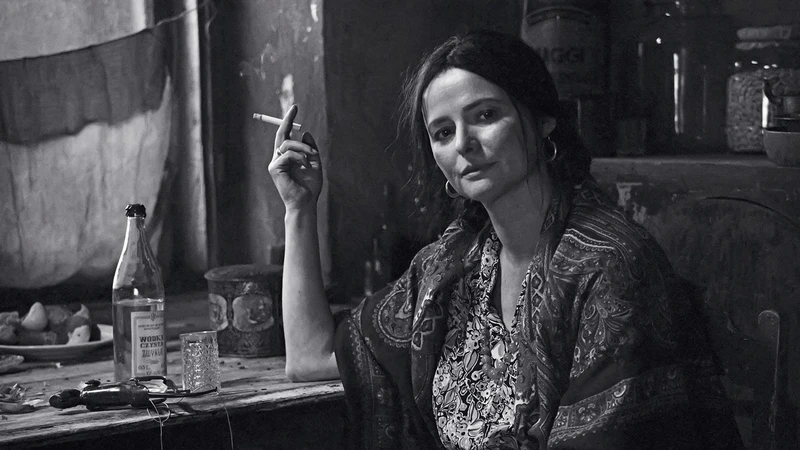
Autores: Aldana Argüello Valenzuela y Carlos Antonio Buscarini.
Aldana Argüello Valenzuela y Carlos Antonio Buscarini
Universidad de Buenos Aires
psiarguellovalenzuela@gmail.com
cabuscarini@juan23.edu.ar
Abstract: The following article will be a dialogue between authors on the mythical legacy of Papusza—the first recorded Romani poet—exploring her poetic works, the experience of the body, the habitat of space, and its relationship to subjectivity. Papusza’s own elaborations, as well as reconstructions of her life by Melissa Cicchetti and Isabel Fonseca, along with the work of Edmund Husserl, Martin Heidegger, Sigmund Freud and Jacques Lacan, will be crucial throughout this exploration. This work will also seek to further highlight Papusza’s enormous artistic heritage and contribute to the construction of the Romani people’s collective memory.
Keywords: Papusza, Rom, habitat, subjectivity, Holocaust, to poeticize
Introduction
This paper emerges from the intersection of two paths, two caravans of thought in the best Romani tradition, which met at the same conference table. The authors of this article met during the XVII International Congress on Research and Professional Practice in Psychology at the University of Buenos Aires in 2025, a fortunate contingency of fate that brought their pens together. Carlos was presenting his paper “Corporeality and Dwelling According to Culture” [1], while Aldana was presenting “Papusza, a Gypsy Po-Ethics: Between Condemnation and Freedom” [2]. The points of consonance and synchrony between the two papers were more than evident. In the days following the Congress, a series of email exchanges continued, weaving together ideas about body, space, and habitat in relation to Romani culture and Papusza’s poetry. Throughout these exchanges, it was argued that her verses bear witness to the experience of inhabiting a particular time and space, while the subjective experience of writing simultaneously configures the very body of the subject: a symbolic body constituted through language and discourse, distinct from the purely “living” organism.
Papusza, which means “doll” in Polish, was the artistic name of Bronisława Wajs (1908/1910–1987). Born in Lublin, Poland, she was a singer, dancer, and fortune-teller, but became best known as the first Romani poet in history to publish her work in written form. Following Romani customs, she grew up nomadically as part of an artistic tabor, a traveling family caravan that performed traditional Rom songs and dances from village to village. For many years, Romani culture was characterized by two central features: it was nomadic, that is, it moved from place to place without a fixed settlement; and it was strictly oral, this being the primary means through which histories and the past were transmitted. Papusza’s talent for dance and singing was evident from an early age, but around the age of eleven an intense curiosity began to inhabit her: the desire to read and write. By exchanging books or chickens with Jewish children in return for secret lessons in reading and writing from village to village [3], combined with a self-taught aptitude, Papusza gradually learned letter by letter and eventually learned to write in Polish. Later, at the age of sixteen, she married a member of the tabor who was twenty-five years her senior. When Jerzy Ficowski, a writer and partisan of the Polish Home Army, found refuge in her tabor while fleeing Nazi persecution, he discovered her poems. Ficowski was moved by their beauty and, upon realizing that no poems by Roma had yet been published in written form, encouraged her to publish her work. She was then recognized in the press of the time as the “first Gypsy poetess.” When her tribe learned of the publications, she was brought before the principal authority of her community for judgment; her expulsion was declared, adding to the simultaneous expulsion from the European spirit that Roma were already suffering under the Nazis (ibid.). Within its oral code, the Romani community regarded the poet’s writings as a betrayal and disclosure of its own secrets, interpreting her act as a transgression rather than as an artistic creation. It is this double and simultaneous expulsion that Papusza was forced to endure.
How does a culture condition the body and the inhabiting of space? How was Papusza’s way of inhabiting configured both within and outside her community? How did the double expulsion she endured affect her psychologically? And how did it affect her relationship to space? What value does the art of writing acquire in this context? These questions will be approached from different angles throughout the text.
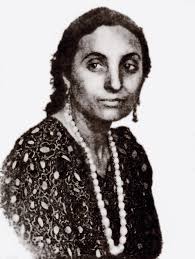
Bronisława Wajs "Papusza"
The Roma and Constant Movement. What Does Dwelling Mean in the Romani World?
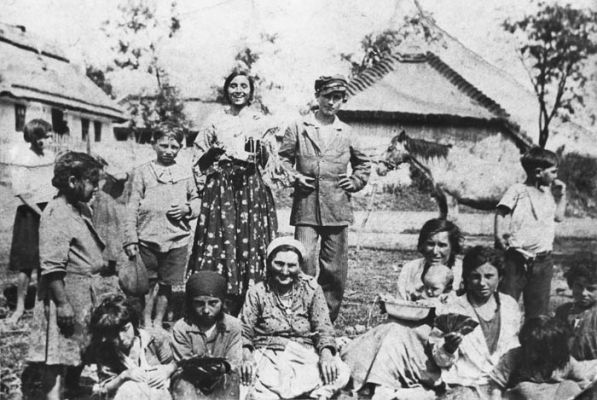
La familia de Papusza
At the lecture delivered at the Vienna Cultural Association on May 7 and 10, 1935, Edmund Husserl referred to the Gypsies: “How is the spiritual structure of Europe characterized? That is, Europe understood not geographically or cartographically, as if one wished to circumscribe the sphere of those who coexist territorially here as European humanity. In the spiritual sense, the British Dominions, the United States, etc., clearly also belong to Europe, but not the Eskimos or the Indians exhibited at fairs, nor the Gypsies who permanently wander throughout Europe” [4].
The expression “wander” may seem somewhat harsh, but the term refers to a way of life without a clearly defined destination, in which the main impulses for movement are freedom and necessity. It is now known that the Roma originated in the Indus Valley region, near Punjab, India, but it is no coincidence that these conceptualizations emerged during periods when the first democracies were being established and the First World War had already taken place, providing the initial impetus for nationalism in the region. And perhaps the Western tendency toward sedentism had more to do with the forms of production and social control that were developing at the time. The persecution of the Romani population has a long history, and perhaps this was also one of the factors behind their constant displacement:
How I wanted

to capture in my poems

the nomadic life.

They would not let the Gypsies live

and they called us dogs.

I, a Poor Gypsy Woman, 1950 [5].
ccording to Paul Ricoeur, “dwelling is composed of rhythms, pauses and movements, fixations and displacements. Place is not merely a hollow in which one can settle, (…) but also an interval that must be traversed” [6]. At this point, one might speak of the Romani philosophy of inhabiting one’s own space as a dance, since dwelling cannot exist without that interval to be traversed, that displacement through the void performed by the body through movement. One dwells through movement.
Since the matrix of nomadism consists in constant displacement, portable tents were commonly erected for brief settlements between journeys. “Pittard describes the usual tent as having two slopes, forming a roof, although there are also conical or semicircular ones, open on one side. (…) And there are even simpler ones: a pair of poles resting against some bushes and covered with a piece of cloth” [7]. Much like the childhood game of building a cave found across cultures, the Roma reproduced this model of temporary, dismantlable shelters.
Nazi Persecution of the Roma
But this desire to travel without constraints was curtailed with the rise of the Third Reich. The extermination of the Roma formed part of the Nazi program for Germany. A decree issued on December 14, 1937, further aggravated the situation of this population by classifying them as “habitual criminals.” In 1938, Heinrich Himmler—head of the Gestapo and the police—personally intervened to order the transfer of the National Central Office for Gypsy Affairs from Munich to Berlin. In his book L’Allemagne et le génocide, historian Joseph Billig distinguishes three forms of genocide: through the suppression of reproductive capacity, through deportation, and through extermination [8]. In the treatment of the Roma, all three forms were carried out. The Roma refer to the genocide as the Porraimos (“Devouring”) or Samudaripen (“The Great Killing”). The Nuremberg Laws stripped the Roma of all citizenship rights “for the protection of German blood and honor.” Marked with the letter Z for Zigeuner (“Gypsy”), they were sterilized in concentration camps, and more than 250 Romani children were subjected to experiments that led to their deaths.
On August 2, 1944, the gas chambers at Auschwitz were put into operation and nearly 4,000 members of the community were murdered in what is remembered as the “Zigeunernacht”: the Night of the Gypsies. “The breeze drew life from the forest, the scent of pine resin masking the smell of the slaughterhouse. Before sunrise, the four thousand Gypsies in the convoy had been gassed and incinerated” [9]. Thus, three quarters of Europe’s Romani population were murdered by the Nazis; estimates suggest that the number exceeded half a million Roma. Papusza’s painful recollection recounts her flight from the forests and the anguish of moving away from “her father.”
“In the city there was no life for the Gypsies

and in the countryside death dwelled; they killed us.

What could we do? We Gypsy women fled with the children

far from the forest

so that the German dogs would not find us.”

Sad Song, 1951 [10].
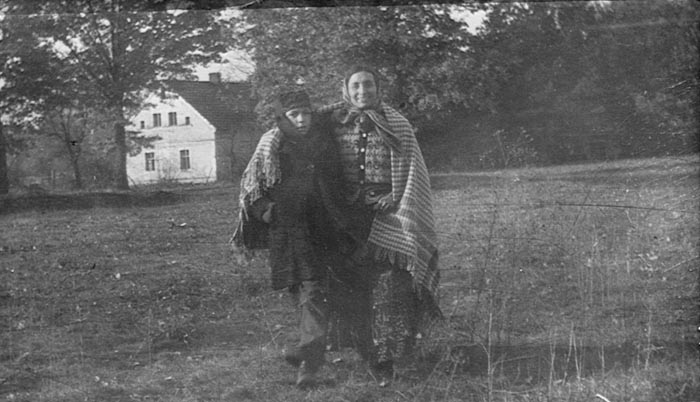
Bronisława 'Papusza' Wajs con su hijo Tarzanio
From this persecution onward, those who managed to avoid capture gradually shifted from the use of tents to another type of shelter that had emerged some time earlier: (…) “At the end of the eighteenth century, Grellmann described entirely underground huts consisting of a pit three to four meters deep, covered with a lattice of crossed branches and, in turn, with straw or grass, leaving only a small opening to allow communication with the outside” [11]. In the 2013 film by Kos-Krauze and Krauze, Papusza, there is a scene in which the tabor hides in the forest from an indiscriminate Nazi massacre, and Dionizy, Papusza’s husband, emerges unharmed from one of these huts.
“The forest, my father”
The forest has been the quintessential habitat of the Roma, both because it provided safety from constant political persecution and because it allowed for a connection with certain customs deeply rooted in nature. During these escapes through the forests, Papusza and her husband encounter a Polish orphan named Tarzanio, whose parents had been murdered by SS officers. They take responsibility for raising him, and by then the period of Nazi persecution had already ended, but the socialist regime had imposed the compulsory settlement of Roma in Poland. Although the Roma did not desire permanent housing, Papusza saw this as a good opportunity for Tarzanio to attend school. Once settled in a house, Dionizy, in the film Papusza, destroys the dwelling in a fit of rage, recalling the following statement: “even if it were to collapse tomorrow, it will remain forever true that the house existed today” [12]. This event is linked to the question of memory:
“Oh, poor and great Gypsies!

How do you survive in this world

without knowing how to read or write?

One day you will no longer be here,

death is taking you one by one.

And nothing of you will remain.”

I, a Poor Gypsy Woman, 1950 [13]
An allusion to the concept of the “forest” for the Roma emerges with full force in a scene from the film in which an Order from the Office of Internal Affairs approves the settlement of the Romani population. A discussion begins within the group, during which the Patriarch asks Ficowski to leave so that the members of the tabor can make a decision among themselves. Some consider it convenient to accept the houses they are offered, while others oppose the idea. One Romani woman says: “No one is going to tell me what to do with my children.” Another Roma member states: “We come from the earth. We sleep and eat upon it. We do not need their houses. The forests are enough for us.” This is how they live their way of being in the world. Heidegger’s formula, “Dasein is being-in-the-world,” written with hyphens, means that the human being [Dasein] and the world are correlative; one is inconceivable without the other. More than that, the human being is human and is world. Of course, we use “man” here in the sense of human being.
Once again, we place this Romani feeling toward the forest in parallel with our understanding of phenomenology and quote the essayist María Zambrano: “And the distant vision of the barely visible center, and the vision offered by the clearings in the forest, seem to promise, more than a new vision, a medium of visibility in which the image becomes real and thought and feeling identify with one another without this requiring that one be lost in the other or that either be annulled” [14]. For Husserl, it is undeniable that feelings possess an intentional reference to an object: “pleasure or displeasure are directed toward the represented object, and without this direction they cannot exist” (…) “the specific essence of pleasure requires reference to something pleasurable” [15]. These are genuine acts of our senses. Thus, intentionality is, in addition to being a form of thought, a means of consciousness through which it is directed toward what can be known and relates what is present to a psychological context.
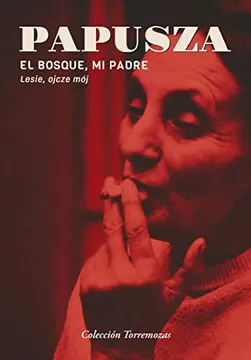
Portada del libro “El bosque, mi padre”, de Papusza (2019). Editorial Torremozas.
Poeticizing Space and Time
Phenomenological hermeneutics calls us at this point. Martin Heidegger, one of the leading figures of 20th-century philosophy, states that “(…) poetically man dwells…” [16]. He also points out that: “It would be crude to declare dwelling and poetic creation irreconcilable.” But how can the dwelling of every human being be grounded in the poetic? What is ordinarily called dwelling is having a place to live. To poeticize is, properly speaking, to let dwell, and letting dwell is a form of building. Poetic creation, before anything else, places the human being upon the earth, brings them to it, brings them into dwelling [17]. The philosopher continues when examining the relationship between thinking and poeticizing: “Between the two, thinking and poeticizing, there reigns a hidden kinship, because both make use of and expend themselves in the service of language for language. Yet between them there is also an abyss, for they ‘dwell on the most widely separated mountains’” [18].
Bearing in mind the circumstances Papusza had to endure, we must repeat the question posed by the German Idealist poet Friedrich Hölderlin: “…and what are poets for in these times of distress?” [19]. This question—why be a poet in times of hardship—and the relationship between thought, poetry, dwelling, and language make it indispensable to turn to Sigmund Freud and Jacques Lacan. Throughout her life, Papusza developed her writing as a way of putting her daily experience into words: displacement, nature, and feeling. In Creative Writers and Day-Dreaming, Freud points out that, at first, play occurs in childhood in a form that is later abandoned and transferred in adulthood into the realm of mental fantasy. In Freud’s words: “Should we not look for the first traces of imaginative activity as early as in childhood? The child’s best-loved and most intense occupation is with play. Perhaps we may say: every child at play behaves like a creative writer, in that he creates a world of his own or, rather, rearranges the things of his world in a new way which pleases him. It would be wrong to think he does not take that world seriously; on the contrary, he takes his play very seriously and expends large amounts of emotion on it. The opposite of play is not what is serious but… what is real” [20]. “The creative writer does the same as the child at play. He creates a world of fantasy which he takes very seriously, that is, which he invests with large amounts of emotion, while separating it sharply from reality” [21].
Loss in the Face of Catastrophe: Art and Identity
What stands out in Papusza is the function of writing in processing her simultaneous double expulsion—first persecuted by Nazi state forces for being Romani, and later expelled from her own tabor because of her poetry. This double process subjected her to prolonged periods situated between mourning and melancholia. Although they differ, both, according to Freud, are “(…) the reaction to the loss of a loved person, or to the loss of some abstraction which has taken the place of one, such as one’s country, liberty, an ideal, and so on.” At the same time, Freud points out that “(…) in some people the same influences produce melancholia instead of mourning.” In mourning, the loved object is understood to have been lost, and an arduous process begins, piece by piece, of withdrawing the libido invested in that object and returning it to the ego, so that it may later be invested in other objects. In melancholia, the loss is unconscious: the subject knows that an object has been lost, but not “what” has been lost in that object, and thus “the shadow of the object falls upon the ego” through reproaches and other formations [22]. It may have been through the particular process of sublimation that Papusza was able to give a destination to both the sexual drive and the aggressive drive (hetero- and self-destructive) in a production socially accepted as artistic work [23], with writing functioning as an attempt at mourning and symbolic binding in the face of so much loss. As Isabel Fonseca notes, “Papusza’s songs, like most Gypsy songs, were anguished laments of poverty, impossible love and, later, longing for a lost freedom.”
In my old age

I have learned to be wise. /

I will never again set foot

where the Gypsies once were beneath the dark night.

Where the children listened

to the nocturnal song of the birds of death.

I Will No Longer Walk Those Old Gypsy Places, 1952 [25]
If habitat has been able to shelter entire families according to kinship rules, studied among others by Claude Lévi-Strauss, what happens when habitat and the family foundations that sustained it are lost? It is important to emphasize the subjective impact that may result from being suddenly stripped of every human right to inhabit Polish territory, while being persecuted by police forces and, at the same time, being displaced from one’s lifelong family circle. The French psychoanalyst Jacques Lacan had already developed in his text On Psychic Causality (1946) the idea that the ego is not a formation given from birth, that it is not an original datum, and that it is fictively formed through interactions with the environment, more precisely through the image configured in the mirror and the bath of language through which we are named by the Other. When the premature child assumes the mirror image as their own, identification occurs, the psychic act that constitutes the ego for Lacan [26]. But this is not a psychic act that the child achieves alone; it depends on culture and on a symbolic other who sustains the child and indicates that “the one you see in the mirror is you.” Later, throughout adult life, the question becomes whether the Other surrounds that “ego” with words and includes it within discourse, or whether the Other violates it or, worse still, excludes it from discourse altogether. The ego is thus formed from fragments of the Other’s discourse. How might this subjective catastrophe that abruptly opened up in Papusza’s life have affected her? What psychic effects might it have produced?
Thought as Dance, a Possibility of Movement
We point here to the powerful poetic idea of thought as a space of displacement for Papusza, despite so many prohibitions, persecutions, and confinements. Hermeneutic phenomenology allows us to reinforce the concepts mentioned above; we do so through a study by Elsa Ballanfat, who grounds her claims in Heideggerian texts: “For Heidegger, thought is dance and movement because it is rhythm. Thought also spaces itself, has its cadences, its moments of repetition before a new argument or a new idea breaks through, just as the voice of a soloist stands out after orchestral passages” [27].
Creative capacity and the dance of ideas became a space that Papusza knew how to use to transform her anguish into poetry, moving through the world of prose as her people moved nomadically across untamed lands. “Just as the wind carries pollen and seeds from strange plants and trees, giving variety and vigor to indigenous flora, so this people preserves in its racial memory various forms of behavior, folk art, music and, perhaps above all, an intuitive sense of natural forces that we are in danger of forgetting and losing in our urban conception of contemporary life” [28].
Regarding Romani life in community, the tabor remained in contact during its travels with other caravans of the same clan following different routes. They left signs at crossroads: a bundle of sticks tied with a red cloth, a branch broken at a certain point, a bone with a notch. Polish Roma call these signs shpera (and elsewhere patrin, or “leaf,” from Kosovo to Peterborough). Villagers do not touch these signs for fear that they are things of the devil [29]. When Husserl studies the social act as a communicative act, he uses the following curious example: “Gypsies who, at a crossroads, place branches so that their companions may find the path they have taken” [30]. What might have motivated his choice of this example? We can only suggest a comparison, without presuming any unconscious motivation: for Heidegger explicitly, and for Husserl implicitly, philosophy is a “being on the way,” since Husserl conceived phenomenology as an infinite task within the community of phenomenologists. The final scene of the film Papusza shows a Gypsy caravan splitting at a crossroads, while a text by Papusza calls for the unity of all Roma.
It seems appropriate here to insist on the hospitality that Papusza’s tabor extended to the poet Ficowski, precisely because this is such a complex matter. We therefore turn to an essential text that invites reflection. Jacques Derrida and Anne Dufourmantelle approach the foreigner not only as an individual who comes from another country or geographical territory, but as the figure who puts the ethics, law, and sovereignty of the home to the test. The mere presence of the foreigner raises the fundamental question of how we relate to alterity and to what lies outside. Regarding how to receive what is foreign, they propose hospitality not as a simple act of courtesy or a rule of good manners, but as an aporia or irresolvable contradiction. It is an ethical opening toward the “Other,” the outsider, structured by a constant tension between two dimensions: unconditional hospitality (the law), which requires opening the doors of the house or nation to the newcomer absolutely, without requiring a name, papers, or explanations. It means hosting the other without imposing conditions or forcing them to adapt to our culture or language. Conditional hospitality (the laws), by contrast, is the actual legal and political framework of States and societies. It operates through rules, limits, agreements, and control of space. Hospitality toward the foreigner is granted provided that they identify themselves, respect the local order, and comply with certain conditions [31].
Both authors identify a tragic dilemma within hospitality: if it remains purely unconditional, the host loses control of their own house or territory in relation to the guest. But if too many conditions and borders are imposed, hospitality becomes corrupted and turns into a mechanism of armed or political exclusion. It is up to us to navigate this irreducible tension without losing a humane regard for the other.
Final Reflections
After Papusza’s death, her figure was reclaimed by new generations. At her home in Gorzów Wielkopolski there is a commemorative plaque and statue. In 2013, directors Joanna Kos-Krauze and Krzysztof Krauze made Papusza, a black-and-white biographical film with exquisite cinematography, accompanied by a soundtrack of accordions, guitars, violins, and Gypsy songs that frame the harrowing path this woman traversed through her po-ethical act (Argüello Valenzuela, 2025). Every April 8, International Roma Day is commemorated in remembrance of the First World Romani Congress, held in London on April 8, 1971, where the Romani flag and anthem were established. The flag is blue for the sky, green for the fields, with a red wagon wheel at its center representing the journey from India toward freedom. The Romani anthem, Gelem, gelem (“I Went, I Went”), commemorates those who suffered under Nazism. Today, the struggle for nationhood and the expansion of rights continues [32].
Papusza’s legacy deserves to be known and disseminated. Her life was undoubtedly a struggle to fulfill her vocation as a poet despite the obstacles she had to confront. She had the courage to narrate the atrocities endured by her people during the war she witnessed. Her hope that fraternal unity among her people might one day become a reality never faded.
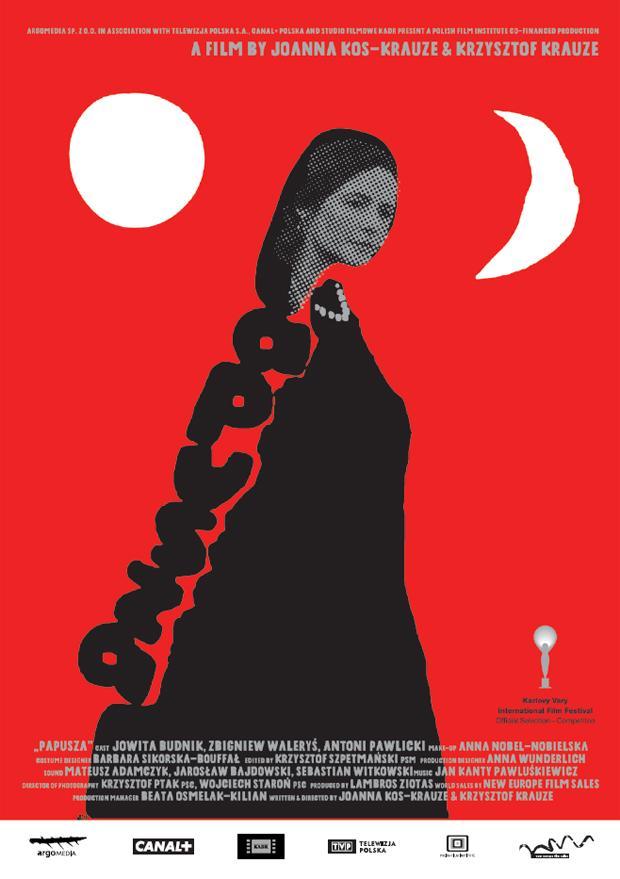
Flyer del film Papusza (2013) de Joanna Kos-Krauze y Krzysztof Krauze (Fuente: Amazon Prime Video)
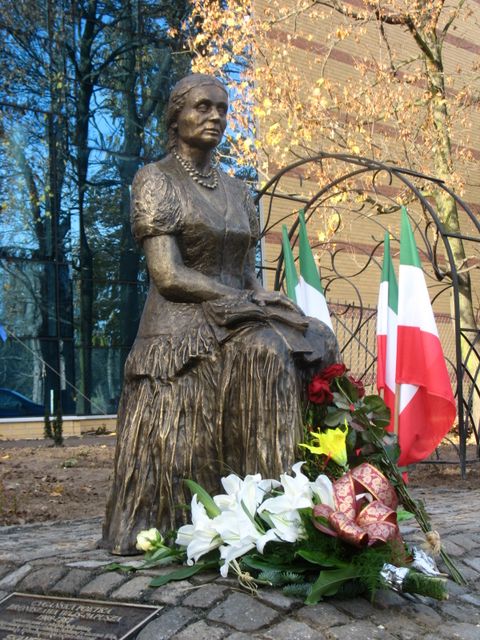
Monumento a Papusza en Gorzów Wielkopolski (Fuente: Wikimedia Commons)
Footnotes
[1] Buscarini, Carlos Antonio (2025). La corporalidad y el habitar según la cultura. XVII Congreso Internacional de Investigación y Práctica Profesional en Psicología. XXXII Jornadas de Investigación. XXI Encuentro de Investigadores en Psicología del MERCOSUR. VII Encuentro de Investigación de Terapia Ocupacional. VII Encuentro de Musicoterapia. Facultad de Psicología – Universidad de Buenos Aires, Buenos Aires. https://www.aacademica.org/000-004/43
[2] Argüello Valenzuela, Aldana (2025). Papusza, una po-ética gitana: entre la condena y la libertad. XVII Congreso Internacional de Investigación y Práctica Profesional en Psicología. XXXII Jornadas de Investigación. XXI Encuentro de Investigadores en Psicología del MERCOSUR. VII Encuentro de Investigación de Terapia Ocupacional. VII Encuentro de Musicoterapia. Facultad de Psicología –
Universidad de Buenos Aires, Buenos Aires. https://www.aacademica.org/000-004/39
[3] Melissa Cicchetti, Papusza: Poetisa, gitana y feminista. En Carmen Rivero Iglesias (Ed.), Deconstruyendo narrativas de subordinación: la crítica feminista del humanismo clásico, Madrid, Editorial Dykinson, 2023, pp. 73-83.
[4] Edmund Husserl, La filosofía en la crisis de la humanidad europea, en La filosofía como ciencia estricta, Buenos Aires, Nova, 1962, p.104 (cursiva nuestra).
[5] Papusza, El bosque, mi padre, Madrid, Torremozas, 2019, p. 45.
[6] Paul Ricoeur, Arquitectura y narratividad. Arquitectonis. Barcelona. Universitat Politécnica de Catalunya, 2002, p. 16.
[7] Jules Bloch, Los gitanos, Buenos Aires, EUDEBA, 1962, p. 26.
[8] Myriam Novitch, El exterminio planificado por los nazis, El Correo de la UNESCO, Año XXXVII, 1984, p. 24.
[9] Alfredo García Francés, La noche de los gitanos, Adhara, Granada, 2012, p. 30.
[10] Papusza, El bosque, mi padre, cit, p. 43.
[11] Jules Bloch, Los gitanos, cit., p. 26.
[12] Maurice Merleau-Ponty, Fenomenología de la percepción, Barcelona, Planeta-De Agostini, 1984, p. 89.
[13] Papusza, El bosque, mi padre, cit., p. 45.
[14] María Zambrano, Claros del bosque, Barcelona, Seix Barral, 1986, p. 5.
[15] Edmund Husserl, Investigaciones lógicas, Madrid, Revista de Occidente, pp. 506, 507.
[16] Martin Heidegger, Conferencias y artículos, Barcelona, Ediciones del Serbal, 1994 p. 163.
[17] Martin Heidegger, Conferencias y artículos, cit., pp. 164-167.
[18] Martin Heidegger, ¿Qué es eso de filosofía?, Buenos Aires, Sur, 1960, pp. 58-59. La cita es del poema de Hölderlin, Patmos, vv. 12-13.
[19] Friedrich Hölderlin, Poesía completa, Barcelona, Ediciones 29, 1995, Pan y vino, 7, p. 321.
[20] Sigmund Freud, El creador literario y el fantaseo, en Obras completas, Vol 9, Buenos Aires, Amorrortu, 1992, p. 127.
[21] Id., p. 128.
[22] Sigmund Freud, Duelo y melancolía, en Obras completas, Vol 14, Buenos Aires, Amorrortu, 1993, pp. 241, 243 y 244.
[23] Jean Laplanche, & Jean-Bertrand Pontalis, Diccionario de psicoanálisis. Barcelona, Paidós, 1996, p. 415.
[24] Isabel Fonseca, Enterradme de pie, Barcelona, Anagrama, 2009, p. 12.
[25] Papusza, El bosque, mi padre, cit., p. 79.
[26] Jacques Lacan, Acerca de la causalidad psíquica, Escritos 1, pp. 117-118.
[27] Elsa Ballanfat, La danza en Heidegger, México, Fractal, 2021, N° 94, p. 4.
[28] Gerald Barry, Los Gitanos. Un pueblo errante desde hace dos mil años. El Correo de la UNESCO, 1958, Año II N° 4, p. 7.
[29] Isabel Fonseca, Enterradme de pie, cit., p. 11.
[30] Edmund Husserl, Zur Phänomenologie der Intersubjektivität. Husserliana XIV, Den Haag, Nijhoff, 1973, p.166.
[31] Jacques Derrida y Anne Dufourmantelle, La hospitalidad, Buenos Aires, Ediciones de la Flor, 2000, p. 81.
[32] Aldana Argüello Valenzuela, Papusza, una poética gitana: entre la condena y la libertad, cit., p. 11.
References
Argüello Valenzuela, Aldana (2025). Papusza, una po-ética gitana: entre la condena y
la libertad. XVII Congreso Internacional de Investigación y Práctica
Profesional en Psicología. XXXII Jornadas de Investigación. XXI Encuentro
de Investigadores en Psicología del MERCOSUR. VII Encuentro de
Investigación de Terapia Ocupacional. VII Encuentro de Musicoterapia.
Facultad de Psicología –
Universidad de Buenos Aires, Buenos Aires.
https://www.aacademica.org/000-004/39
Ballanfat, E (2021). La danza en Heidegger. Fractal. N° 94 (1-16).
Barry, G (1958). Los Gitanos. Un pueblo errante desde hace dos mil años. EL Correo
de la UNESCO, Año II N° 4 (4-8).
Bloch, J (1962). Los gitanos. Buenos Aires. EUDEBA.
Cicchetti, M (2023). Papusza: Poetisa, gitana y feminista. En Carmen Rivero Iglesias
(Ed.), Deconstruyendo narrativas de subordinación: la crítica feminista del
humanismo clásico, Madrid, Editorial Dykinson, (73-83).
Derrida, J y Dufourmantelle, A (2000). La hospitalidad. Buenos Aires. Ediciones de la
Flor.
Fonseca, I (1995). Enterradme de pie. La odisea de los gitanos. Barcelona:
Anagrama.
Freud, S (1992/1908). El creador literario y el fantaseo. En Obras completas, Vol 9.
Buenos Aires. Amorrortu (123-135).
Freud, S (1993/1917). Duelo y melancolía. En Obras completas, Vol 14. Buenos Aires,
Amorrortu. (235-256).
García Francés, A (2012). La noche de los gitanos, Adhara, Granada.
Heidegger, M (1994). Conferencias y artículos, Barcelona, Ediciones del Serbal.
Heidegger, M (1960/1956). ¿Qué es eso de filosofía? Buenos Aires, Sur.
Hölderlin, F (1995). Poesía completa, Barcelona, Ediciones 29.
Husserl, E (1962/1910-11). La filosofía en la crisis de la humanidad europea. En La
filosofía como ciencia estricta. Buenos Aires, Nova.
Husserl, E (1976/1900-1901). Investigaciones lógicas. Madrid. Revista de Occidente.
Husserl, E (1973). Zur Phänomenologie der Intersubjektivität. Husserliana XIV, Den
Haag, Nijhoff.
Lacan, J (2005/1999/1966). Acerca de la causalidad psíquica (1946). En Escritos 1.
Buenos Aires. Siglo XXI Editores (151-190).
Laplanche, J & Pontalis, J-B (1996). Diccionario de psicoanálisis. Barcelona, Paidós.
Merleau-Ponty, M (1993/1945). Fenomenología de la percepción. Barcelona.
Planeta-De Agostini.
Novitch, M (1984). El exterminio planificado por los nazis. El Correo de la UNESCO,
Año XXXVII, (24-25).
Ricoeur, P (2002). Arquitectura y narratividad. Arquitectonis. Barcelona. Universitat
Politécnica de Catalunya (9-29).
Zambrano, M (1986). Claros del bosque, Barcelona, Seix Barral.
Film references
Kos-Krauze, J., & Krauze, K. (Directores). (2013). Papusza [Película]. Argomedia;
Telewizja Polska – Agencja Filmowa; Studio Filmowe KADR.
*Automatic translation for english version