Banner headline
Gina Katherine Pastrana Urueña
Universidad del Tolima
Asociación Civil Estudio Sahar
ginakatherine@gmail.com
Abstract: The khawalat were male dancers in Cairo during the eighteenth and nineteenth centuries who enjoyed a degree of social recognition. However, their presence has largely been concealed because raqs sharqi was documented by Western writers and painters as an essentially female practice. Drawing on travel accounts, historical sources, academic studies, and contemporary reports, this article examines the trajectory of the khawalat from their earliest documented mentions to their possible presence in the present day. It explores the ways in which these dancers were described and interpreted by Western observers, as well as the semantic and social transformations associated with the figure of the khawal. In addition, it recovers the memory of historical and contemporary dancers whose practices challenge the gender boundaries commonly attributed to this dance. The article concludes that male participation has been a persistent, though frequently overlooked, component of this dance tradition.
Key words: male dance, Egypt, gender, khawal, orientalism, raqs sharqi.
Khawalat: the “Belly Dancers”
Raqs sharqi [1], the dance of the Orient, became known in the West through the descriptions of 19th-century European travelers. This process coincided with the growing incorporation of dance into entertainment circuits linked to tourism in Egypt, turning it into an important economic activity. Various authors have pointed out that these representations, which overwhelmingly focused on female dancers, defined the dance for Western audiences as feminine (Karayanni, 2004; Roushdy, 2010; Sellers-Young, 2014). As a consequence, male participation received less attention, and male dancers—the khawalat—were classified as imitators. This interpretation has largely persisted due to the heteronormative perspective of European travelers who, as Karayanni (2004) argues, tended to analyze these practices from a perspective external to the Egyptian social context, where male dancers formed part of a consolidated and socially recognized artistic tradition. In addition, certain contemporary interpretations of raqs sharqi developed in Western contexts have treated this dance as representative of a mystical and ancestral femininity. Shay (2006) adds that this has contributed to the historical presence of men in raqs sharqi receiving less attention.
Methodological note. Quotations taken from sources originally published in English and French are presented in Spanish translation by the author.
Before the Khawalat
Shay (2006) notes that, from pre-Islamic times and throughout the development of the Islamic world, there have been male figures associated with dance who adopted female clothing and roles. These individuals did not constitute an isolated phenomenon, as they appear under different names depending on the culture: mukhannathun in Arabia, zenne or köçekler in the Ottoman world, bacha bāzī in Afghanistan, and khwaja sara or hijra in South Asia; all referring to young men dressed as women who performed professions and occupations traditionally associated with women. Although in some contexts they were relatively accepted, most occupied socially ambivalent positions or were rejected (Fortier, 2021; Shay, 2006).
In his diary from 1670–79, Dr. John Covel makes an early reference to these dancers in Türkiye:
There was a charming and delicate boy,
about 10 years old,
with hair as beautiful and long as that of most women.
Dancing with him was a handsome man (about 25 years old), both Turks.
[…] They were so well liked that there was hardly a night when they did not perform somewhere or other.
(Bent, 1893, p. 214)
These cross-dressed men were poorly received by 19th-century European travelers, and their very existence may have seemed strange to them.
The First Khawalat
Edward Lane (1836) was the first to use the word khow’al (hereafter khawal) when describing festivities surrounding the marriage ritual.
On the morning after the marriage, the khow’als [2] or gha’zee yehs [3] (men or women who dance) perform in the street before the bridegroom’s house, or in the courtyard (Lane, 1836a, p. 240)
However, it is in the second part of his book, in the chapter “Public Dancers,” that he describes them:
As they personate women,
their dances are exactly of the same description as those of the Ghawa'zee;
and they accompany themselves, in the same manner,
with the sound of castanets: but,
as if to prevent their being thought really women,
their dress is suited to their unnatural profession;
being partly male and partly female:
it consists chiefly of a close-fitting vest,
a girdle, and a kind of petticoat.
Their general appearance, however,
is more feminine than masculine:
they allow the hair of the head to grow long, and generally braid it,
after the manner of women: the hair of the face, when it begins to grow, they pluck out; and they also imitate women by applying kohhl and hhen'na to their eyes and hands.
In the streets, when they are not dancing,
they often even veil their faces;
not from shame, but simply to affect the manners of women.
They are often employed, in preference to the Ghawa'zee,
to dance before a house, or in the court,
on the occasion of a marriage feast,
or the birth of a child, or a circumcision;
and they frequently perform at public festivals.
(Lane, 1836b, p. 105)
From this initial description, the khawal are portrayed as imitators, not only of female dancers but of women themselves, and this male profession is characterized as unnatural and shameful. This became the image that persisted in the West: cross-dressed men dancing like women. Yet it is striking that, for Egyptians, these artists were often preferred over female dancers.
Lane (1836) also mentions another group of male dancers (Jewish, Armenian, Greek, and Turkish) with characteristics similar to those of the khawal, but foreign, known as gink.
In Cairo, the khawalat occupied a social niche and fulfilled a respectable and morally accepted social role in private celebrations, festivals, and communal occasions (Biancani, 2012). This is evidenced by the 1801 French list of Cairo guilds, which includes a guild of male dancers—Corporation 139—who were hired under the same conditions as the ghawazee, their female counterparts (Fraser, 2015).
Their performances were accepted by Egyptians, as Stoddard (1881) shows when he writes: “It is the almeh, the ghazeeyeh, the khawal, or the gink that brings fire to the eye, blood to the cheek, and joy to the heart of the Muslim, unless he be exceptionally devout” (p. 183). However, they were not to the taste of European travelers, who found their performances anything from graceless to morally questionable:
The performance of the chauel or male dancer is not much better than that of the female dancer. Dressed and adorned like a dancing girl, he performs the same kind of movements as on other nights to the delight of the spectators. […] This class of hermaphrodites, a product of the luxurious East, also resembles the dancing girls in their abandoned morals. (Klunzinger, 1878, p. 191)
In Nerval’s (1930) description, however, one can perceive acceptance and admiration for the beauty of the dance:
And now here are the almées appearing before us in a cloud of dust and tobacco smoke.
[...] the hips trembled with a voluptuous movement;
the waist appeared bare beneath the muslin between the jacket and the rich loose sash falling very low,
like the girdle of Venus. Amid the dizzying whirl,
one could barely distinguish the features of these graceful people, whose fingers shook cymbals as large as castanets,
and who fought valiantly to the primitive sound of flute and tambourine. There were two who were very beautiful,
with proud bearing, Arab eyes illuminated by kohl, full and delicate cheeks lightly painted;
but the third, it must be said, betrayed a less tender sex with an eight-day beard:
so that, on looking more closely, and once the dance was over and I was able to distinguish the features of the other two more clearly,
it did not take me long to become convinced that we were dealing only with almées... male ones. (p. 88)
A few lines later, however, he wondered why Egyptian morality prohibited the spectacle offered by female dancers but allowed “dances by men with effeminate features, long hair, bare arms, waist, and neck, who so deplorably parody the half-veiled charms of female dancers” (Nerval, 1930, p. 89).
The prohibition to which Nerval refers derived from an edict issued by Muhammad Ali Paşa in June 1834 [4]—very similar to Napoleon’s edict of 1799 [5]—which prohibited all forms of prostitution and public female dancing within Cairo and ordered the deportation of any woman known or suspected to be involved in these activities. Through this measure, Muhammad Ali sought to counteract the negative image that Egyptian popular arts projected before foreigners (Berger, 1961), a position that coincided with that of other sectors of society that rejected the eroticized interpretation of dance promoted by European observers (Van Nieuwkerk, 1995).
The edict did not apply to the khawalat, who could perform openly for the entertainment of foreign visitors in Cairo. However, in colonial literature and European travel accounts of the period, these dancers were frequently (mis)interpreted through Western sexual categories, leading to their association with homosexuality, cross-dressing, and prostitution. In this regard, Boone (2014) notes that, because they were perceived as imitators of femininity, they were attributed sexual practices supposedly available to other men, in a reading saturated with cultural and colonial prejudice.
It was probably from this period onward that the meaning of the term khawal began to undergo semantic transformation. In 19th-century sources such as Lane’s An Arabic-English Dictionary (1863), the term appears associated with the idea of “slave” or “servant”; later, Dozy (1881) records it as already linked to the figure of the “dancer.” In modern usage, Wehr (1976) broadens its semantic field to include meanings such as “dancer” and “effeminate person,” revealing an additional evaluative charge in its evolution. In this sense, Karayanni (2004) and Shay (2006) point out that khawal was historically used to refer to male dancers, although in contemporary Egypt the term has acquired pejorative connotations associated with homosexuality. For this reason, in current contexts, terms such as raqqas [6] or raqsandeh are preferred, as they are considered more neutral in social and gender terms (Shay, 2006).
The assumption that the khawalat were usurping a female dance, and the feminization of the dance itself, probably began to take shape in the late 19th century, when most descriptions of dance centered on the ghawazee and the awalim. However, Berger (1961) describes the danse du ventre as a folkloric practice performed by boys, girls, men, and women in different communities, noting that in these contexts its sexual dimension is moderate, whereas in its stage version it acquires a more erotic character (p. 17). In this description, Berger does not link belly dance to a specific gender or sexual identity, but rather presents it as a socially shared practice that varies according to context. The author also mentions cases of male dancers whose artistic performance did not correspond to their sexual lives, such as Ahmed el-Fakir, recorded by Saleh (1979), who worked as both a khawal and a carpenter. From this perspective, it is possible to suppose that travelers of the period tended to interpret these practices through more rigid frameworks of gender and sexuality than those reflected in the sources described.
Shay (2006) adds that historically most professional dancers came from the lower or impoverished sectors of society and that their sexual activities could have been linked to economic dynamics rather than to defined sexual identities. In this sense, the author distinguishes between the historical existence of homosexual practices and the modern idea of homosexuality as an identity.
The khawalat did not wear specifically female garments unless they were performing a female role—as in other cultures—but rather costumes designed to emphasize their movements and draw attention to the performance they presented (Lane, 1838; Shay, 2006). It could be argued that in Cairo, as in other Islamic communities such as Oman (Wikan, 1977), there existed a specific dress code for men, women, and cross-dressed men, a code unfamiliar to Western observers and therefore contributing to the perception that the dancers dressed in the same way as women.
Unfortunately, there is not much additional information regarding dancers in 19th-century Cairo, despite their strong presence. According to Metin And (1959, cited in Shay, 2006), this was because the Western gaze regarded dance as an inappropriate activity for men, especially when practiced professionally. The few travelers who left records of the khawalat emphasized their supposedly loose morals and obscene character.
The Khawalat Emerge from Anonymity
In the reports, the names of the khawalat were omitted, leaving them almost always anonymous. The first known name is that of Hassan El-Bilbesi, who was very fashionable in 1849–1850 and was described by Gustave Flaubert (1910) as follows:
A dancer—it was Hassan El Bilbesi:
his hair arranged and his dress like a woman’s, his hair gathered into a diadem,
embroidered vest, eyebrows painted black, very ugly,
[...] he plays the crotales—splendid movements of the belly and hips—
moves his belly like a wave—
a great final salute in which his trousers, having puffed out,
collapse (p. 195).
Flaubert records two encounters with Hassan el Bilbesi, who on one occasion performed alongside “another” dancer (Flaubert, 1910). In his descriptions, Flaubert emphasizes both Hassan’s skill and his physical appearance, describing him as “ugly.” From Karayanni’s (2009) perspective, this criticism could be understood as a device that allowed the writer to displace or conceal a possible fascination—considered transgressive in his time—with the figure of the male dancer.
After this khawal, there is only one further mention, that of Mohammed, a dancer from the Turkish Village at the 1893 Chicago World’s Fair, who was considered the best dancer at the Fair: “Many who saw him insisted that he was a woman. For the skill of his movements, his leaps, and the control of his body, he was incomparable” (Carlton, 2002).
In The Moulids of Egypt (McPherson, 1941), a dancer in women’s clothing is described: Husein Foad:
A very well-known character, a unique star in his style
[…] He always danced in the dress, ornaments, hair,
lipstick, and mannerisms of a woman,
and people watching for the hundredth time could hardly believe that he was not what he appeared to be.
(McPherson, 1941, p. 84).
No other reference to Husein Foad has been found, apart from a full-page photograph appearing later in the book.
Ward (2025) documents that by the 1970s the names Afifi and Sisa were recognized as dancers active at weddings in the Luxor region. Both came from the village of Samaneen (east of Luxor). Afifi worked mainly in the Qurna area, while Sisa worked in the Luxor area, although they occasionally collaborated at the same celebrations. Ward notes that, like the khawalat of earlier periods, Afifi and Sisa displayed feminized characteristics in their clothing and gestures. This gender ambiguity allowed them access to social spaces restricted to other men, including the harem, where they were invited to entertain the women of the family.
Some years later, Mosbah Baalbaki, a Lebanese dancer (b. 1972), stood out in Beirut’s nightlife scene:
He glides, contorts, shakes, provokes.
His heavily made-up face holds the gaze of the crowd.
His body, [...] controls every one of his movements as he takes over the stage and makes it his own,
captivating an enthusiastic audience. (Daily Star, 2004).
In his article on this artist, Sachs (2000) states that Mr. Baalbaki does not perform a drag show or a striptease, removing its erotic and sexual character; it is “more like an encounter between ‘Saturday Night Fever’ and ‘The Thousand and One Nights’,” thus locating him between two Western constructions to which he does not belong, while in his own country, marked by strong religious conservatism, his profession is criminalized (Karayanni, 2004).
In an interview with Maalouf (2004), the artist acknowledges that his dance is often associated with his sexuality, but clarifies that he does not seek to promote “sexual freedom,” stating: “I am only a dancer, and my private life concerns only me.” Likewise, he insists that his work is not intended to provoke or protest. However, according to Sachs (2000), he also points out that even female dance is socially rejected, intensifying the stigmatization of the male dancer. His testimony thus demonstrates the persistence of the taboo and a symbolic hierarchy in which the male dancer remains even more marginalized than his female counterpart.
In the United States, John Compton (1948–2012) described himself as a contemporary khawal, challenging the exclusive association of raqs sharqi with femininity. Sellers-Young (2016) describes his stage persona as embodying a masculinity “as fluid as his hips and as malleable as his spine,” that is, a bodily representation that historically would have been read as feminine.
Moreover, because his early performances featured female Moroccan-inspired clothing, long hair, and makeup, he developed a deliberately ambiguous stage image that, throughout his career, proved difficult to classify within binary gender categories and was instead described as “exotic.” Finally, after his career, the term khawal virtually ceased to be used to refer to dancers in these contexts.
Figure 1 shows images of three of the khawalat mentioned above.
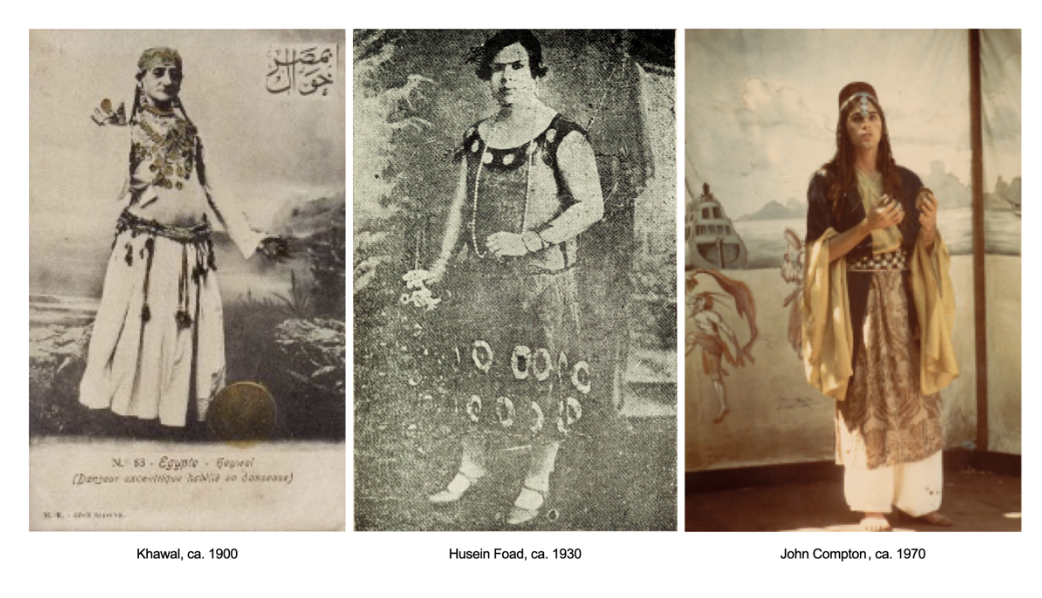
Figura 1. Un bailarín egipcio, Husein Fouad y John Compton representando a la tradición de los Khawalat.
Nota. Composición elaborada por la autora. Fotografía de un Danzante masculino (khawal) en vestimenta femenina, Egipto. Tomado de Wikimedia Commons (s. f.). Fotografía de Husein Foad, reproducida en McPherson (1941), lámina entre las pp. 84-85.Fotografía de John Compton, tomada de Remembering John Compton, por Suhaila International, Octubre 16, 2012, Suhaila International's Blog (https://suhailainternational.wordpress.com/2012/10/16/remembering-john-compton/). El autor de la fotografía original es desconocido.
Modern Khawalat
The dancer Ibrahim (Robert Abraham “Bobby”) Farrah (1939–1998), of Lebanese origin, proposed a typology of male Oriental dance in which he distinguishes three stylistic orientations: an “expressionist” style, characterized by an intense relationship with space and bodily gravity; a “conservative” style, in which more limited, fluid, and graceful movements predominate within a restricted repertoire and with little use of the performance space; and a “free” style, defined by greater openness in the exploration of movement and an expansive use of the performance space, with loose shoulder movements, ornamental arms, and a moderate presence of hip movement, associated with an expression of bodily expansiveness (Sellers-Young, 2016, p. 115).
Based on this classification, it can be observed that Farrah’s interpretation, as presented by Sellers-Young, distinguishes between forms of male dance that are close to the technique of female raqs sharqi and others that deliberately restrict bodily mobility. The latter typology falls within what Shay (2009) calls the “hypermasculinization” of dance, in which male expression tends to be reduced to a more rigid repertoire, centered on torso stability and the limitation of pelvic movement, often functioning as structural support for the female artistic display. At no point is any mention made of the costumes worn by the dancers.
Observation of contemporary attire allows for a categorization into three groups: those who retain the traditional Egyptian galabeya; those who adopt a more Ottoman-style costume, with baggy trousers, vests, and boots; and those whom I consider to follow the tradition of the khawalat, combining male and female garments adapted for performance.
It is within this last category of modern khawalat that I include the Egyptian Tommy King (Hatem Hamdy), Igor Kitshka from Brazil, Rashid Alexander from Curaçao, and Eshan Hilal from India (Figure 2).
The dancers to whom I refer are established, internationally renowned artists, with very different backgrounds and highly individual styles. Yet, when observing their dance, it is difficult not to recall descriptions from two centuries ago. It is also noteworthy that, like Hassan el Bilbesi and Housan Foad, they maintain a male gender identity, use their male names, and certainly do not imitate women. They have created their own styles of dance, delicate, expressive, deeply felt, and beautifully performed.
Their costumes, remarkable for their beauty, play along the boundary between the feminine and the masculine: fitted galabeyas embellished with sequins and sheer fabrics, or flowing, voluminous skirts secured by wide, richly decorated belts, together with beautifully embroidered and ornate vests. It cannot be claimed that these garments are copied from female models; rather, they have simply adapted their costumes to their dance.
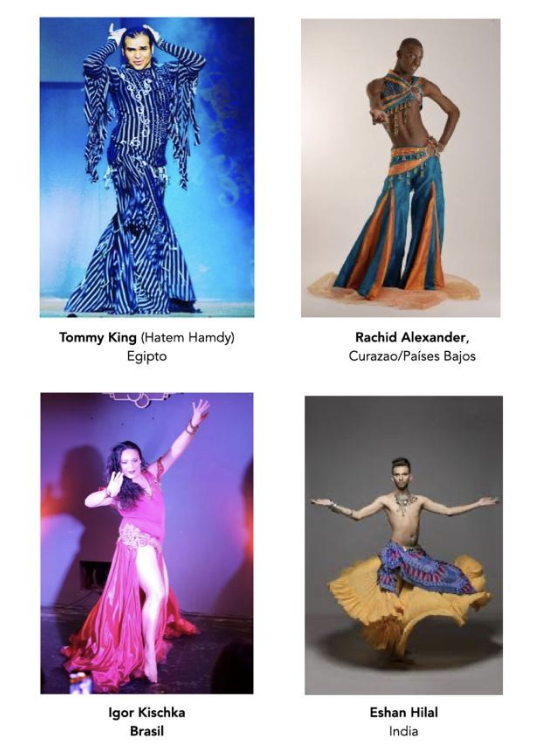
Figura 2. Ejemplos de bailarines contemporáneos cuyas propuestas escénicas incorporan elementos tradicionalmente asociados a los khawalat.
These and other similar artists keep the art of the khawalat alive, perhaps without realizing it, and thanks to them, perhaps, raqs sharqi dancers will cease to be regarded—both by audiences and by their fellow artists—as mere imitators of women.
Final Reflection
Fifi Abdo, the famous Egyptian dancer, expressed the following opinion in an interview:
“A man dancing belly dance? They can perform folkloric dances, but it is impossible for a man to dance real belly dance. The term itself describes the area from the hips to the waist, and there a man lacks the energy that a woman has. They can perform, but they cannot dance belly dance” (Sachs, 2000).
This comment demonstrates that the 19th-century travelers’ idea that men who perform Oriental dances are imitators of women, and that “true Oriental dance” is far from being a male domain, remains present in our own time.
It is possible that today, with the modern, open, and inclusive mindset of the 21st century, we would no longer describe male belly dance as unnatural or shameful, but can we accept that the dance also belongs to men? Even today, when exploring “the feminine” in men has become fashionable, when we see a delicate and expressive male dance, do we not think, hear, or perhaps even say: “He dances beautifully, like a woman!”?
The challenge is to understand that dance has no gender; that there is no male style and female style, but rather personal style; and that just as clothes do not make the man, costume does not determine the dancer. These men dancing in the 21st century, breaking with frameworks created by 19th-century minds, represent all the forgotten dancers, and a visual comparison (Figure 3) makes it possible to identify aesthetic continuities between both periods.
Perhaps the term khawalat will no longer be heard, since the word has become an insult, but the art and the artist can still be recognized, and one can continue to enjoy male belly dance embellished with veils, skirts, finger cymbals, and movements that allow us to forget the person and enjoy the essence: the dance.
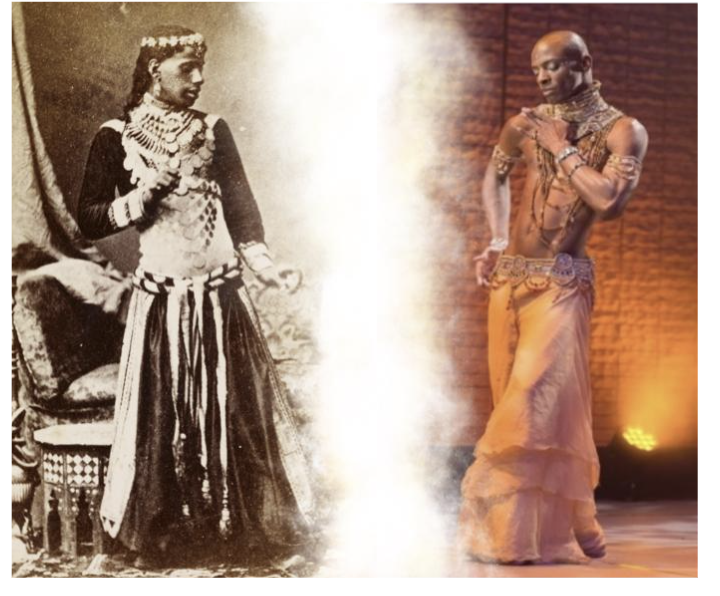
Figura 3. Comparación visual entre un khawal histórico y un bailarín contemporáneo.
List of Figures
Figure 1. An Egyptian dancer, Husein Fouad, and John Compton representing the khawalat tradition.
Figure 2. Examples of contemporary male dancers whose stage performances incorporate elements traditionally associated with the khawalat.
Figure 3. Visual comparison between a historical khawal and a contemporary male dancer.
Footnotes
[1] Raqs sharqi. An expression used in Egypt to refer to the performance dance that evolved into what is known in the West as belly dance. I use the term here because the khawalat were Egyptian dancers, although their dance was probably referred to as raqs baladi, or popular dance.
[2] Although the Arabic plural of khawal is khawalat, the use of a plural form created by incorrectly adding an “s” at the end became common, having been popularized by early travelers. The most common term is khawal, although many other spellings can be found, such as khow’al, khowal, käwal, khowal, khöwal, chauel, and haywal; however, the most common form in written sources is khawal.
[3] The term used for the public female dancers of Cairo was gha’zee yehs (pl. ghawa’zee), hereafter Gaziya/Ghawaze, in distinction from the almeh/awalim, who danced in private settings.
[4] The edict was repealed in 1850 by Abbas Paşa, the grandson of Muhammad Ali Paşa.
[5] During an outbreak of plague, all “women of ill repute (al-nisa al-mashurat)” were prohibited from entering Cairo for 30 days, as they were considered potential transmitters of the plague. Anyone found unlawfully harboring them faced the death penalty. This prohibition also included female dancers suspected of prostitution.
[6] Raqqas: male dancer; raqsandeh: dancer (m), dancer (f).
References
Asyut. (2011, febrero). Rachid Alexander [Entrada de blog]. Danza del Vientre – Danza oriental y tribal. http://bailadanzadelvientre.blogspot.com/2011/02/rachid-alexander.html
Bent, J.T. (1893). Early voyages and travels in the Levant with some account of the Levant Company of Turkey Merchants. The Halycut Society. https://ia800201.us.archive.org/25/items/earlyvoyagestrav00dallrich/earlyvoyagestrav00dallrich.pdf
Berger, M. (1961). The Arab Danse Du Ventre. Dance Perspectives.
Biancani, F. (2012). “Let down the courtains around” Sex work in Colonial Cairo, 1882—1952. [Tesis doctoral]. London School of Economics and Political Science.
Boone, J.A. (2014). The homoerotics of Orientalism. Columbia University Press.
Carlton, D. (2002). Looking for Little Egypt. IDD Books.
Daily Star. (2004, February 13). Male belly dancer shimmies his way into people’s hearts. Ahbab News. http://ahbab.blogspot.com/2004/02/male-belly-dancer-shimmies-his-way.html
Dozy, R. (1881). Supplément aux dictionnaires arabes (X, Vol. 1). E. J. Brill. https://gallica.bnf.fr/ark:/12148/bpt6k6254645z/f451.item.texteImage.zoom
Dublin Belly Dance. (2023). Igor Kischka live 2023 gallery [Galería fotográfica]. https://www.dublinbellydance.com/igor-kischka-live-2023-gallery
Flaubert, G. (1910). Voyage en Égypte. Bernard Grasset.
Fortier, C. (2021). Troisième genre et transsexualité en pays d’islam. Droit et cultures (en-ligne), 80(2). https://doi.org/10.4000/droitcultures.6763
Fraser, K. W. (2015). Before they were belly dancers: European accounts of female entertainers in Egypt, 1760-1870. McFarland And Company.
Karayanni, S. S. (2004). Dancing fear & desire: Race, sexuality, and imperial politics in Middle Eastern dance. Wilfrid Laurier University Press.
Karayanni, S. S. (2009). Native motion and imperial emotion: Male performers of the “Orient” and the politics of the imperial gaze. En When men dance: Choreographing masculinities across borders (Fisher, J. & Shay, A., pp. 314-348). Oxford University Press.
Klunzinger, K.B. (1878). Upper Egypt. Scribner, Armstrong & Co. https://archive.org/details/upperegyptitspeo00klunrich/page/n3/mode/2up
Lane, E. (1836a). An account of manners and customs of the modern Egyptians: Vol. I. Nattali and Bond. https://babel.hathitrust.org/cgi/pt?id=hvd.hn6adf&view=1up&seq=560&q1=dancer
Lane, E. (1836b). An account of manners and customs of the modern Egyptians: Vol. II. Nattali and Bond. https://babel.hathitrust.org/cgi/pt?id=hvd.hn6adf&view=1up&seq=560&q1=dancer
Lane, Edward. (1863). An Arabic-English Lexicon (Vol. 2). Willams & Norgate. http://www.tyndalearchive.com/TABS/Lane/
Maalouf, L. (2004). Dancing against the norms: A profile of Mosbah Baalbaki. Al-Raida, XXI(104-105), 86-87.
http://www.alraidajournal.com/index.php/ALRJ/article/download/380/377/744
McPherson, J.W. (1941). The moulids of Egypt (Egyptian saints days). N. M. Press.
Nerval, G. (1930). Voyage en Orient: Vol. I. Calmann Lévy.
Rachid Alexander. (2019, 22 de julio). [Fotografía de actuación]. Facebook. https://www.facebook.com/Rachid-Alexander–2272599789689443/photos/2393013997648021
Roushdy, N. (2010, agosto). Baladi as Performance: Gender and dance in modern Egypt. Surfacing, 3(1), 171-199.
Sachs, S. (2000, 4 de mayo). Beirut journal; he’s no Salome, but it’s straight from the heart. NY Times. https://www.nytimes.com/2000/05/04/world/beirut-journal-he-s-no-salome-but-it-s-straight-from-the-heart.html
Saleh, M. (1979). A documentation of the ethnic dance traditions of the Arab Republic of Egypt [Tesis doctoral]. New York University.
Schoefft, O. (ca. 1860–1890). Danseur public [Fotografía]. Davis Museum at Wellesley College. https://davis.emuseum.com/objects/11868/danseur-public-from-the-album-souvenir-deqypte-25-types
Sellers-Young, Barbara. (2014). Masculine or feminine — ancient or contemporary: «Raqs Sharqi» and a world of converged images. The World of Music, new series, 3(2), 123-139.
Sellers-Young, Barbara. (2016). Belly dance, pilgrimage and identity. Palgrave Macmillan.
Shay, A. (2006). The male dancer in the Middle East and Central Asia. Dance Research Journal, 38(1 y 2), 137-162.
Shay, A. (2009). Choreographing masculinity: Hypermasculine dance styles as invented tradition in Egypt, Iran and Uzbekistan. En J. Fisher y A. Shay (Eds.), When men dance: Choreographing masculinities across borders (pp. 287–308). Oxford University Press.
South China Morning Post. (2023, 29 de mayo). Why dance and jewellery were made for each other [Artículo con fotografía]. https://www.scmp.com/magazines/style/article/3222135
Stoddard, C. W. (1881). Mashallah! A flight into Egypt. D. Appleton and Company.
Suhaila International. (2012, 16 de octubre). John Compton with Bal Anat, early 1970s [Fotografía]. Suhaila International’s Blog. https://suhailainternational.wordpress.com/2012/10/16/remembering-john-compton/
Tommy King [@tommyking.official74]. (2018, 19 de diciembre). [Fotografía de actuación]. Instagram.https://www.instagram.com/tommyking.official74/p/BrpxXDmFC-z/
Van Nieuwkerk, K. (1995). A trade like any other: Female singers and dancers in Egypt. University of Texas Press.
Ward, H. (2025). Documenting several male professional belly dancers in Luxor. Patreon. Recuperado el [07 de diciembre de 2026] de Ahttps://www.patreon.com/posts/documenting-male-119887411
Wehr, H. (1976). A dictionary of modern written Arabic (3.a ed.). Spoken Language Services Inc. https://www.ghazali.org/books/wehr-cowan-76.pdf
Wikan, U. (1977). Man Becomes Woman: Transsexualism in Oman as a Key to Gender Roles. Man, New Series, 12(2), 304-319.
Wikimedia Commons contributors. (s. f.). Egypte – Haywal (Danseur excentrique habillé en danseuse) [Fotografía]. Wikimedia Commons. https://commons.wikimedia.org/wiki/File:Egypte_%E2%80%93_Haywal._(Danseur_excentrique_habill%C3%A9_en_danseuse).jpg
*Automatic translation for english version