
Evelyn Andersson
Universidad Nacional de Lanús
Asociación Civil Estudio Sahar
evelynandersson15@gmail.com
Abstract: Authenticity in bellydance does not constitute an essential or originary quality; rather, it is a performative construction that emerges from the interaction of stage practices, institutional regulations, legitimizing circuits, and historical processes. These factors shape a dynamic regime of conventions that varies across sociocultural contexts. From this perspective, understanding authenticity as a fixed attribute is insufficient for approaching bellydance as a hybrid and transnational form. This study draws on Bracco (2020), Ward/Nisaa (2024), Butler (1990), and Barrionuevo (n.d.), and examines the power relations at play in a particular moment of Egypt’s identity-formation process, showing how modernity does not displace tradition but reconfigures and resignifies it within eclectic forms.
Keywords: bellydance; authenticity; performativity; cultural hybridization.
Introduction
As in many debates on cultural authenticity, two broad perspectives tend to coexist. The first conceives tradition as a relatively stable heritage that must be preserved from external influences, while the second understands cultural practices as constantly transforming through exchanges, appropriations, and historical resignifications. From this latter perspective, authenticity is not defined by the absence of change, but by the processes through which particular cultural forms acquire legitimacy in specific contexts.
In line with this discussion, Handler and Linnekin (1984) argue that tradition constitutes a symbolic construction rather than a set of inherited and immutable traits. This approach serves as a conceptual framework for analyzing authenticity in bellydance not as a fixed essence, but as a historically negotiated category.
Rather than focusing on the pejorative dispute surrounding “cultural appropriation,” frequently framed in terms of accusation between Egyptian and Western dancers, I propose a historical approach. My purpose is to analyze how contemporary bellydance was configured, which factors intervened in its development, and which cultural representations operated at each stage.
In this study, I understand imaginaries as sets of representations, values, and narratives that delimit which bodies, gestures, and scenes are considered acceptable, desirable, or condemnable at a given historical moment. From this perspective, authenticity in bellydance does not appear as an essential attribute, but as a negotiated and mutable criterion, shaped by transformations in spaces devoted to entertainment and art, by dialogues between nation and culture, and by changes in the market, performance conditions, and regimes of dance visibility. Consequently, bellydance can be understood as a performative practice. Throughout this study, I will use the notion of performative authenticity as an analytical tool to examine the historical and social processes through which particular practices come to be recognized as authentic.
Within this framework, the article traces the evolution of bellydance through an analysis of the imaginaries that shape it across three broad stages. First, a colonial period, in which exoticizing gazes and cultural hierarchies were consolidated and influenced the construction of “the Oriental,” alongside the establishment of nationalist discourses aimed at distinguishing what was considered native from what was foreign. Second, a postcolonial period, in which national projects, mass media, and the cultural industry reconfigured criteria of legitimacy, modernity, and belonging, while performance spaces were transformed and hybrid artistic manifestations emerged. Finally, a stage of globalization and professionalization extending to the present, in which moral and political debates surrounding the body, respectability, and the pu
Bellydance as Performative Authenticity
I argue that bellydance has historically been shaped through an ongoing negotiation around authenticity. In this sense, authenticity does not appear as an essential, natural, or pre-existing quality, but rather as a construction that is produced (or, more precisely, performed) through situated practices, shared codes, and staging decisions.
I propose referring to this logic of production as “performative authenticity,” understood as an analytical category that makes it possible to describe the processes through which certain styles, bodies, and forms of representation come to be recognized as authentic within the field of bellydance. In general terms, Judith Butler argues that identity does not pre-exist its acts, but is constituted through the reiteration of norms and practices that, over time, produce the appearance of a stable core (Butler, 1990). Applied to the field of bellydance, this approach makes it possible to understand authenticity not as a pure origin, but as a regime of conventions that becomes stabilized in practice and validated through circuits of legitimation, institutions, artistic scenes, and market logics, which define which aesthetics, bodies, and modes of performance become visible, acceptable, and ultimately “authentic.”
From this perspective, authenticity is constructed through the articulation of several dimensions identified in the analysis of imaginaries. First, staging (that which is shown) is conditioned by historical contexts and power relations that enable or restrict certain representations; in the case examined here, this dimension is particularly linked to state intervention and its regulatory frameworks. A significant example can be observed during the government of Muhammad Ali, who in 1834 issued an edict prohibiting the presence of female dancers in Cairo and removing them from the sight of foreigners (Bracco, 2015), revealing the direct impact of political power on the regulation of bodies and their forms of display.
Second, repetition (that which becomes naturalized) contributes to the familiarization and consolidation of certain aesthetic and narrative codes through their repeated circulation in mass media; for example, the stabilization of the badlah as a recurring visual sign of what is recognized as bellydance.
Third, legitimation (who validates and with what authority) is manifested through the action of educational institutions and professional circuits that regulate content, enable career paths, and establish criteria of acceptability and authenticity.
Finally, reception (the ways in which audiences interpret) introduces a dynamic dimension, insofar as transformations in social imaginaries modify expectations and interpretations of the dance, configuring bellydance as a field of ongoing dispute. In this regard, it is relevant to note that both the so-called “Western standard” and the “Egyptian standard” coexisted within the same historical process, responding to differentiated logics of production and reception in which audiences operated according to particular cultural codes and aesthetic expectations.
These dimensions will be analyzed in light of three historical frameworks: colonial imaginaries, postcolonial cultural projects, and moral reconfigurations associated with political transformations, as well as the process of institutionalizing its teaching within professional and academic settings. These processes have not only shaped the aesthetics and circulation of bellydance, but have also defined who may legitimize it, under what conditions, and according to which criteria, revealing its capacity for adaptation in the configuration of a hybrid performative art.
To develop this argument, the article aims to:
Identify the colonial imaginaries that contributed to representing “oriental” dance as exoticism, spectacle, or alterity, and evaluate their impact on the construction of legitimacy.
Examine how the postcolonial period reorganized these meanings through national projects, the cultural industry, and mass media, redefining what was considered “modern” and “native.”
Analyze how power relations reconfigure discourses on the body, morality, respectability, and the public visibility of dance, and how these discourses affect its practice and social valuation.
Describe aesthetic and narrative continuities and ruptures in bellydance arising from changes in imaginaries across different stages.
Delimit the analytical use of “authenticity” and “cultural appropriation,” avoiding their reduction to moral accusations and prioritizing a historical reading.
The Colonial Imaginary and Spectacularization in Egypt
The Egyptian colonial and transitional period provides a key framework for understanding how modern bellydance took shape: a field shaped by disputes over legitimacy, morality, and public visibility. From the Napoleonic invasion (1798–1801) and the transformations associated with the rule of Muḥammad ʿAlī (1805–1848), Egypt entered a process of state and cultural transformation in which local projects and imperial pressures became increasingly intertwined. The British occupation, which began in 1882, intensified these tensions and consolidated a context in which material and media modernity coexisted with conflicts surrounding sovereignty, nationhood, and social order (Bracco, 2015).
A structuring element of the colonial imaginary was Orientalism: a Western perspective that tended to construct “the Orient” as a homogeneous category—Oriental/Arab/Muslim—and to turn it into an object of consumption and exoticization (Bracco, 2024). At the same time, local elites negotiated their position within the colonial order through agreements and forms of mediation with imperial powers, including dynamics that can be understood as internal colonialism; that is, forms of differentiated citizenship and paternalistic privileges articulated through gender, class, and state authority (Thompson, 2000). This framework affected not only the way “the West” viewed Egypt, but also the ways in which certain Egyptian sectors began to design, administer, and “render legible” cultural practices, including bellydance, the object of this study, for both local and foreign audiences.
The reconfiguration of culture accelerated with the incorporation of new technologies, institutions, and forms of knowledge circulation. The expansion of print culture, educational missions to Europe, and growing openness toward Western cultural models encouraged the emergence of a new public sphere and debates on education, citizenship, and gender. In this context, the modernization of women began to be presented as a central component of reformist and nationalist projects, articulating ideals of progress, morality, and nation-building (Bracco, 2024).
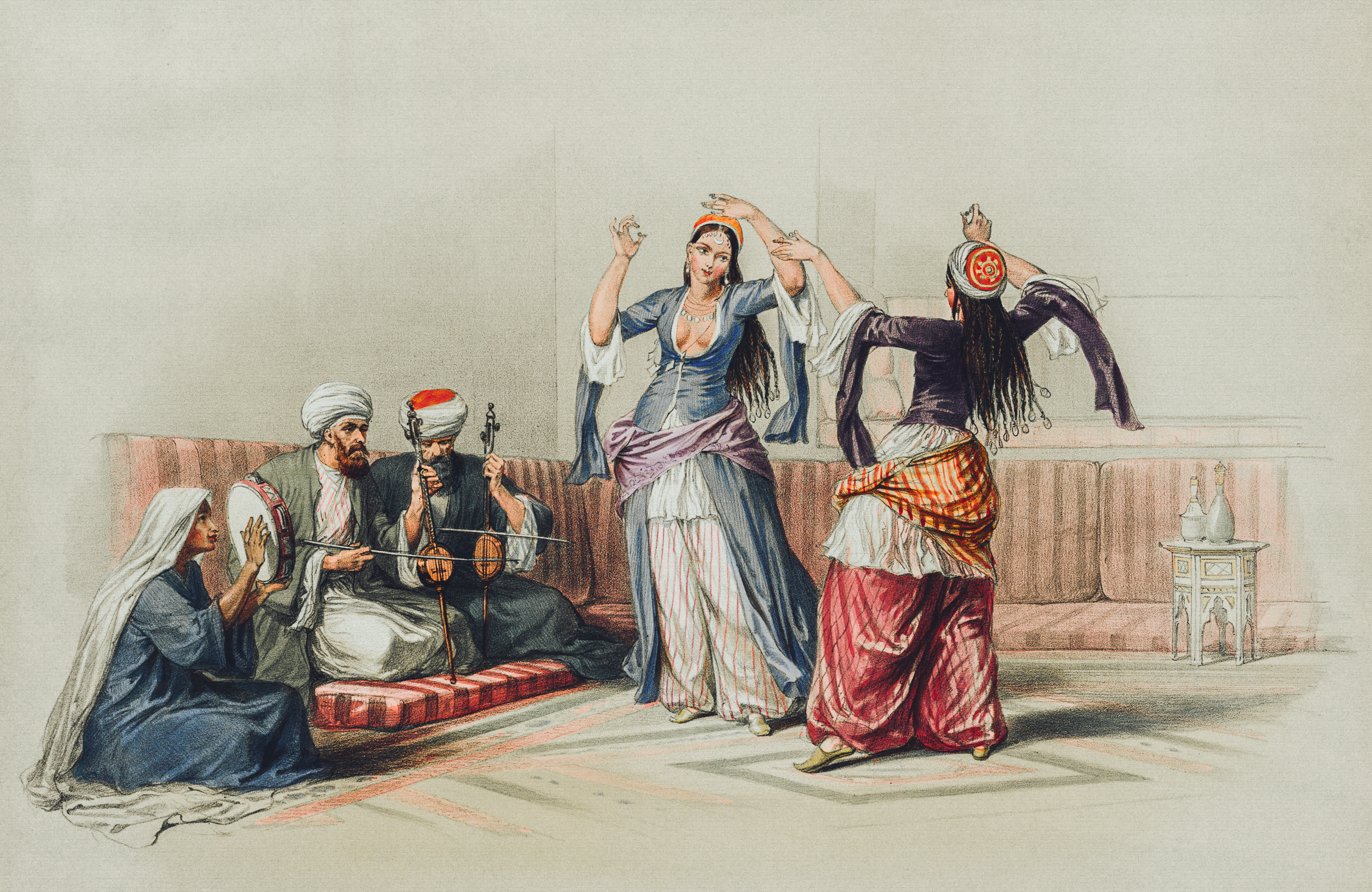
At the same time, Egypt became an increasingly spectacularized society. The expansion of theaters, cafés, music halls, and cabarets generated new leisure spaces in which local and foreign audiences interacted, encouraging the circulation of hybrid cultural practices and the constant negotiation of codes related to consumption, sociability, and stage corporeality (Bracco, 2015; Ward, 2024). These spaces were not merely passive recipients of external influences, but settings in which different actors actively participated in redefining forms of entertainment and cultural representation.
This process was connected to the consolidation of mass media. The spread of the gramophone and the expansion of colloquial songs contributed to the formation of popular audiences, linking cultural consumption with identity formation. More broadly, popular culture operated as a terrain in which “ordinary Egyptians” negotiated nation and identity in relation to British authorities and local elites (Fahmy, 2011). As the 20th century progressed, the film industry became a central mechanism of mass circulation: it consolidated musical formats close to the “filmed cabaret” and expanded transnational aesthetic models (Bracco, 2024).
Within this context, the creation of industrial infrastructure was decisive. Studio Misr was established and officially opened in 1935 under the initiative of Talaat Harb and Banque Misr, becoming a milestone in the industrialization of Egyptian cinema and the subsequent “Golden Age” (Google Arts & Culture, n.d.; Cubero, n.d.). This musical cinema was criticized for its apparent lightness—song, dance, humor—but its cultural relevance lies in the fact that it shaped sensibilities, disciplined ways of looking, and established hierarchies of respectability around the body on stage (Bracco, 2015). Within this framework, the figure of the dancer appears as ambivalent: central to entertainment and, at the same time, subject to constant moral suspicion. The contrast deepened between the bint al-balad, associated with popular respectability, and the dancer associated with the cabaret. Bracco (2024) also observes that, by the late 1950s, this moralization intensified and the dancer in cinema increasingly appeared in narratives linked to corruption or criminality.
Read through the notion of performative authenticity, this period does not define the “authentic” as a stable origin, but rather as an effect produced through repeated and recognized conventions: staging, circuits of legitimation (media, cultural elites, the State, and the market), and audience interpretations. Various imaginaries were consolidated that contributed to representing the dance, then referred to as raqs sharqi, as exoticism, spectacle, and also as a form of alterity: something “other,” different, and often hierarchized. On the one hand, the Orientalist gaze operated by imagining “the Orient” as a homogeneous bloc and reading dance through codes of difference, sensuality, and curiosity. On the other hand, technological advances, capitalism, and the growth of leisure spaces—such as theaters, casinos, and cabarets—promoted a strong process of spectacularization: dance became a cultural product to be watched, consumed, and discussed. It moved from being a dance integrated into social occasions to becoming a form of entertainment and, later, a mass practice adapted to social consumption laden with messages and symbolism.
The impact of these imaginaries on the construction of legitimacy was clearly ambivalent. On the one hand, they favored the public consolidation of the dance: they made it more visible and inserted it into global circuits such as the press, gramophone, and cinema. At the same time, however, they fixed a matrix of moral suspicion around the dancer: she could be celebrated as a star of entertainment and a symbol of modernity, while her respectability remained conditional. In other words, the colonial imaginary not only “displayed” the dance, but also delimited how it should be viewed and under what conditions it could become legitimate. Dance became, at once, both medium and message.
Postcolonial Imaginary: Modernity, Nation, and the Reconfiguration of Bellydance
From the 1950s onward, the Egyptian cultural field entered a postcolonial phase marked by a profound reconfiguration of the State, the public sphere, and the place occupied by the arts within the national project. The Free Officers Revolution (1952) and the rise of Gamal Abdel Nasser promoted a narrative in which the Nation was imagined as a woman who had to be rescued and defended: a metaphor that once again positioned the female body as a symbolic surface of the modern State (Bracco, 2024). Within this framework, the Arab woman began to function as an emblem of postcolonial modernity, while the expansion of schools and socialization policies became linked to the formation of “new national values” (Bracco, 2024).
However, this modernity was far from homogeneous. While part of the elite promoted Western models of progress, another sector reaffirmed religion as a way of distancing itself from that Westernization (Bracco, 2024). The “modern” in the postcolonial period was not defined as a simple imitation of the West, but rather as a constant dispute over what kind of modernity should be incorporated and displayed. This tension deeply affected entertainment and popular culture: the more widespread these expressions became, the more intensely their place within the moral and national order was debated. The central question running through this period was: how could a modern nation be built without losing what was considered specifically Egyptian or Arab?
Within this context, the Nasserist cultural project incorporated artistic figures as part of its symbolic construction. Umm Kulthum, for example, became established as “the voice of Egypt” and as an icon of cultural identity and national pride, developing a significant relationship with the new regime (Danielson, 1997). Likewise, composers such as Mohamed Abdel Wahab and Riad al-Sombati revitalized traditional forms such as the qasida within modern musical formats capable of circulating widely through radio, cinema, and recordings. From this perspective, culture began to function as an instrument of cohesion: it not only represented “the Egyptian,” but also helped produce it as a collective sentiment.
These transformations also found one of their main spaces of representation in cinema. During the postcolonial period, a shift toward more realistic films began to gain prominence, with greater interest in everyday life, inequalities, and social conflicts. Within this transformation, the figure of the cabaret dancer became increasingly associated with the old regime and with suspicious morality: she was condemned as a symbol of decadence or corruption (Bracco, 2024). Here, an important difference emerges in relation to the previous period. The issue was no longer only exoticism or spectacle, but a political and moral reading in which the cabaret could function as a metaphor for a past that the new State wished to leave behind.
Within this new cultural and moral climate, the figure of the dancer as a “femme fatale” also became increasingly consolidated: a representation shaped by desire, danger, and moral ambiguity. Frequently, scenes were no longer centered on professional dancers as narrative protagonists, but were instead embodied by actresses such as Hind Rostom, who played female characters marked by anguish, psychological violence, or rebellion (Bracco, 2024). The female body thus became the site through which cinema dramatized the boundaries between desire, social order, and control. Along these lines, the lives of popular sectors began to be portrayed with greater harshness, and films starring figures such as Tahia Carioca and Hoda Sultan combined entertainment with social narrative (Bracco, 2015).
Another key element of the postcolonial imaginary was folklorization. The State began to define what constituted “folklore” and national heritage, selecting, organizing, and “filtering” those elements that could be publicly represented as legitimate popular culture (Bracco, 2024). In 1957, the Ministry of Culture established the Center for Folk Arts with the aim of preserving and revitalizing the country’s traditions, marking the beginning of a more systematic state cultural policy concerning popular arts.
This process can be understood through the notion of “invented tradition”: not because tradition is “false,” but because it is constructed through processes of selection, reorganization, and staging of cultural materials intended to produce a coherent image of the nation (Hobsbawm & Ranger, 1983/1987). Within this framework, groups such as the Reda Troupe and the Firqat Qawmiyya participated in an aesthetic in which the “popular” appeared organized, stylized, and presented through a modern lens. In many filmed works and official performances, young dancers were presented as students and modern citizens: disciplined and “educated” bodies embodying a form of folklore suitable for national and international representation (Bracco, 2024).
It is precisely here that the notion of authenticity begins to shift. The issue no longer lies solely in whether a practice is “traditional” or not, but in who possesses the authority to decide which tradition is shown, how it is represented, and under what conditions it can become legitimate. Authenticity thus ceases to function as a fixed essence and begins to emerge as a construction shaped by institutions, cultural discourses, and mechanisms of representation.
At the same time, the mass reach of cinema also began to become a matter of State concern. By the mid-1950s, regulations, censorship, and interventions had increased, and by the 1960s the incorporation of the film sector into public control had advanced. The entry of the industry into the state sector is related, for example, to the nationalization of Studio Misr in 1960 and to subsequent processes of broader state control over the industry.
In this way, cinema functioned simultaneously as industry, entertainment, and a tool for managing sensibilities: which bodies could circulate, how desire should be framed, and which behaviors were narratively rewarded or punished (Bracco, 2024). The screen not only reflected the cultural transformations of postcolonial Egypt, but also actively contributed to producing them.
Finally, this cycle reached a symbolic and political rupture with the 1967 defeat against Israel, an event that reshaped social expectations and opened the way toward a shift in ideological climate that would prove decisive for the following stage.
Globalization and the Incorporation of Bellydance into Professional and Academic Fields
With the death of Gamal Abdel Nasser in 1970 and the rise of Anwar Sadat, Egypt’s political and social climate began to be reconfigured within a context marked by economic difficulties, inequality, and cultural transformations. At the same time, discourses linking female respectability with modesty and virtue gained strength, progressively shifting the discussion of authenticity from the aesthetic sphere toward the terrain of public morality (Bracco, 2024).
Following the defeat of 1967, and within a regional context influenced by the expansion of religious movements and new transnational networks, pressure increased on cultural practices associated with entertainment and bodily display. As a result, the legitimacy of bellydance increasingly depended on where it was performed, who performed it, and under which moral codes it was interpreted. As the local environment became more restrictive, the dance found new spaces of circulation, transformation, and legitimation in the West.
In the United States, bellydance underwent a process of reconfiguration linked to Arab migrant communities and the development of its own artistic scene. Performance spaces evolved from small cafés and nightclubs to large stages, consolidating structured performance formats and an increasingly close relationship between musical composition and choreographic spectacle. As A. J. Racy (2011) points out, musicians such as Eddy Kochak incorporated elements of jazz and American music into repertoires connected to the Arab diaspora and the emerging bellydance circuit, demonstrating processes of cultural negotiation and artistic hybridization.
Within this context, figures such as Jamila Salimpour contributed to systematizing teaching through the creation of specific terminology and more structured methods of transmission. Oral teaching began to be complemented by manuals, training programs, and formalized pedagogical approaches. At the same time, artists such as Anahid Sofian and Ibrahim Farrah promoted the incorporation of dance into increasingly complex theatrical circuits, a process that decades later would reach an international scale through productions such as Bellydance Superstars.
Meanwhile, in Egypt, tensions between culture, morality, and public space persisted, periodically generating challenges to the legitimacy of dance and the figure of the dancer. In Western circuits, however, bellydance began to acquire new forms of recognition associated with art, physical activity, personal development, and academic research.
From the perspective of performative authenticity, this stage reveals a fundamental shift: legitimacy no longer depends exclusively on Egyptian cultural institutions or specific national frameworks, but on a transnational network of festivals, schools, artistic companies, stage productions, and academic spaces that actively participate in defining what is considered authentic within the field of bellydance.
Final Reflections
In the first stage, colonial imaginaries constructed bellydance primarily as exoticism, spectacle, and alterity: a “different” cultural form that became consumable when it fit expectations of the curious, the sensual, or the exotic. This gaze did not remain solely “outside,” but was articulated with internal transformations: the growth of urban entertainment spaces, the press, and new technologies such as the gramophone and cinema gave the dance greater public visibility, although under rules that rendered it legible as spectacle and not necessarily as respectable art (Bracco, 2015).
This stage not only contributed to the spectacularization and mass circulation of the dance, but also to delimiting the ways in which it should be observed, interpreted, and legitimized. Understanding these historical processes is fundamental to understanding how the first modern criteria of performative authenticity began to be constructed, in which legitimacy no longer depended solely on the practice itself, but also on who observed it, under which cultural codes, and within which spaces of representation.
During the postcolonial period, this tension deepened as bellydance began to undergo transformations on stage. The dance incorporated elements from ballet, Hollywood musicals, tango, flamenco, and other Western styles. Dancers no longer improvised only at social celebrations or in popular spaces, but began to develop a much more elaborate theatrical presence. Samia Gamal represented one of the clearest examples of this process: she incorporated expansive traveling movements, ballet-inspired turns, high-heeled shoes, and a visual aesthetic influenced by Hollywood, while continuing to be perceived as “the Egyptian dancer.” Her figure demonstrates how authenticity did not operate as a fixed essence, but rather as a cultural construction capable of integrating diverse elements without losing social legitimacy.
Dance and the figure of the dancer then began to be reorganized within a new political and cultural framework. On the one hand, the State promoted a “legitimate” national culture through figures and institutions, with Umm Kulthum as a national icon and folklorization as administered heritage. On the other hand, condemnation of the cabaret as a symbol of the past intensified, while the dancer became increasingly associated with the figure of the “femme fatale,” the “demonic woman,” or narratives of moral corruption. In this context, authenticity ceased to be defined solely by the origin of a practice and came to depend on who possessed the authority to represent what was Egyptian, to decide which bodies could occupy public space without stigma, and to establish what could be displayed as legitimate national folklore. Thus, the postcolonial period consolidated a new performative logic in which dance began to function simultaneously as a cultural symbol, a political tool, and a space of identity negotiation.
In the final stage, bellydance ceased to be defined exclusively by Egyptian national frameworks and became a global practice traversed by moral, professional, and academic disputes. While in Egypt the dance continued to be subject to social surveillance and challenges related to public morality, in the West it began to circulate through new spaces of legitimation associated with performance, fitness, empowerment, and university research. The professionalization of teaching, the systematization of technique, the expansion of international festivals, and transnational circulation through audiovisual media and social networks profoundly transformed its modes of circulation and learning.
In this context, the discussion of authenticity ceased to focus solely on “how traditional” a practice is and shifted toward more complex questions: who possesses the authority to represent the dance, how cultural identities are negotiated, and in what ways global transformations reconfigure what is considered legitimate or authentic.
Across this historical trajectory, both continuities and ruptures can be identified. The principal continuity is that, in every stage, the dancer functions as a central site of dispute regarding social order: her visibility, legitimacy, and the ways in which her body may be publicly displayed are continually negotiated. The most marked rupture, by contrast, lies in the dominant criterion of legitimacy. During the colonial period, the logic of the exotic and spectacular prevailed; during the postcolonial period, a logic associated with nation, education, and heritage was privileged; while in contemporary globalization, bellydance shifted from a primarily national framework toward a global, transnational, and deeply fragmented field of legitimacies, in which there is no longer a single legitimate center of cultural authority.
These transformations reorganized the social mechanisms surrounding the dance, although they did not eliminate the underlying tension. Far from remaining static, bellydance continued to transform alongside the historical, political, and cultural processes that affected both Egypt and its global circuits. Its fusions, reconfigurations, and disputes do not necessarily imply a loss of authenticity, but rather the continuation of a history marked, from its origins, by constant negotiations between tradition and modernity, spectacle and legitimacy, body and representation. In this sense, the authenticity of bellydance cannot be understood as a fixed essence or as a pure and immutable origin, but rather as a performative and historical construction that is continuously redefined according to the cultural, political, and social contexts in which the dance circulates.
References
Barrionuevo, M. (s. f.). Bailarinas y el cine [Clase grabada]. Profesorado en Historia del
Bellydance.
Bibliothèque nationale de France. (s. f.). The francophone press of Egypt | Patrimoines
Partagés.
Bracco, C. (2024). Cine y género en el Mundo Árabe. Ciudad Autónoma de Buenos
Aires: Libretto.
Bracco, M. C. G. (2015). Espacio público y mujeres en Egipto: Un recorrido por la
imagen y el imaginario social de las bailarinas (Tesis de Licenciatura).
Universidad de Granada.
Butler, J. (1990). Gender trouble: Feminism and the subversion of identity. Routledge.
Cubero, A. V. (s. f.). Nuevos realizadores en el mundo árabe: el caso de… [PDF].
Universidad Carlos III de Madrid.
Danielson, V. (1997). The Voice of Egypt: Umm Kulthūm, Arabic Song, and Egyptian
Society in the Twentieth Century. University of Chicago Press.
Fahmy, Z. (2011). Ordinary Egyptians: Creating the Modern Nation through Popular
Culture. Stanford University Press.
Google Arts & Culture. (s. f.). Studio Misr Buildings.
Hobsbawm, E., & Ranger, T. (Eds.). (1983/1987). The Invention of Tradition. Cambridge
University Press.
Racy, A. J. (2011). Recordings of belly dance music in the United States in the 1940s
and 1950s. En Representations of Middle Eastern Music (p.48). Antonine
University. Recuperado de:
https://ua.edu.lb/Library/Assets/Gallery/AntonineUniversity/rtm-5-2011-racy.pdf
Silvera, A. (1980). The first Egyptian student mission to France under Muhammad Ali.
International Journal of Middle East Studies.
Thompson, E. (2000). Colonial Citizens: Republican Rights, Paternal Privilege, and
Gender in French Syria and Lebanon. Columbia University Press.
UCL Equiano Centre. (s. f.). Mahmoud Mukhtar: Egypt Awakened.
University in Cairo Scholarship Online. (s. f.). The beginning of printing in Egypt.
Ward, H. D. (2024, julio 14). From Café Chantant to Casino Opera: The evolution of
theatrical performance space for bellydance [Conferencia virtual]. Estudio
Sahar.
*automatic translation to english

2 comments
На данном веб-сайте вы сможете обнаружить нужную информацию.
https://relax-spb.ru/read-info/1095-bpla-obrushilos-na-passazhirskiy-avtobus-v-starobelske-kak-udalos-spasti-lyudey.html