
Leticia Martin
Universidad de Buenos Aires
Asociación Civil Estudio Sahar
leticiadanielamartin@gmail.com
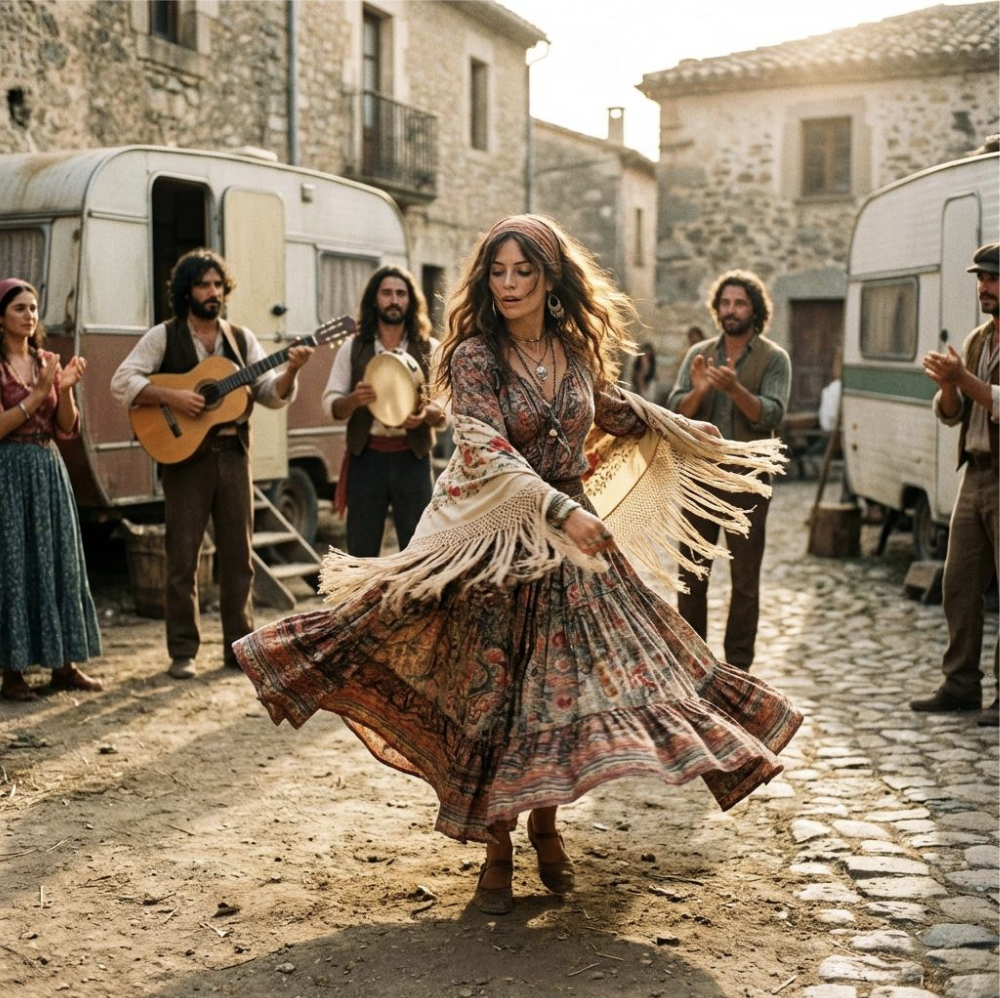
Abstract: This paper aims to explore the concept of the “gypsy” style within the belly dance repertoire. Its objective is to unravel the style’s origins and clarify its proper conceptualization as a Romani style. Drawing on various sources, the text examines the social perceptions surrounding the “gypsy” style stereotype, the etymology of the word “gypsy”, and its correct association with the term “Romani.” Finally, a selection of archival photographs of actual Romani people is included, alongside an image generated using “Nano Banana” AI prompts, to illustrate these stereotypes through the use of new technology.
Keywords: gypsy style, rom, dance, style
Origin of the Term
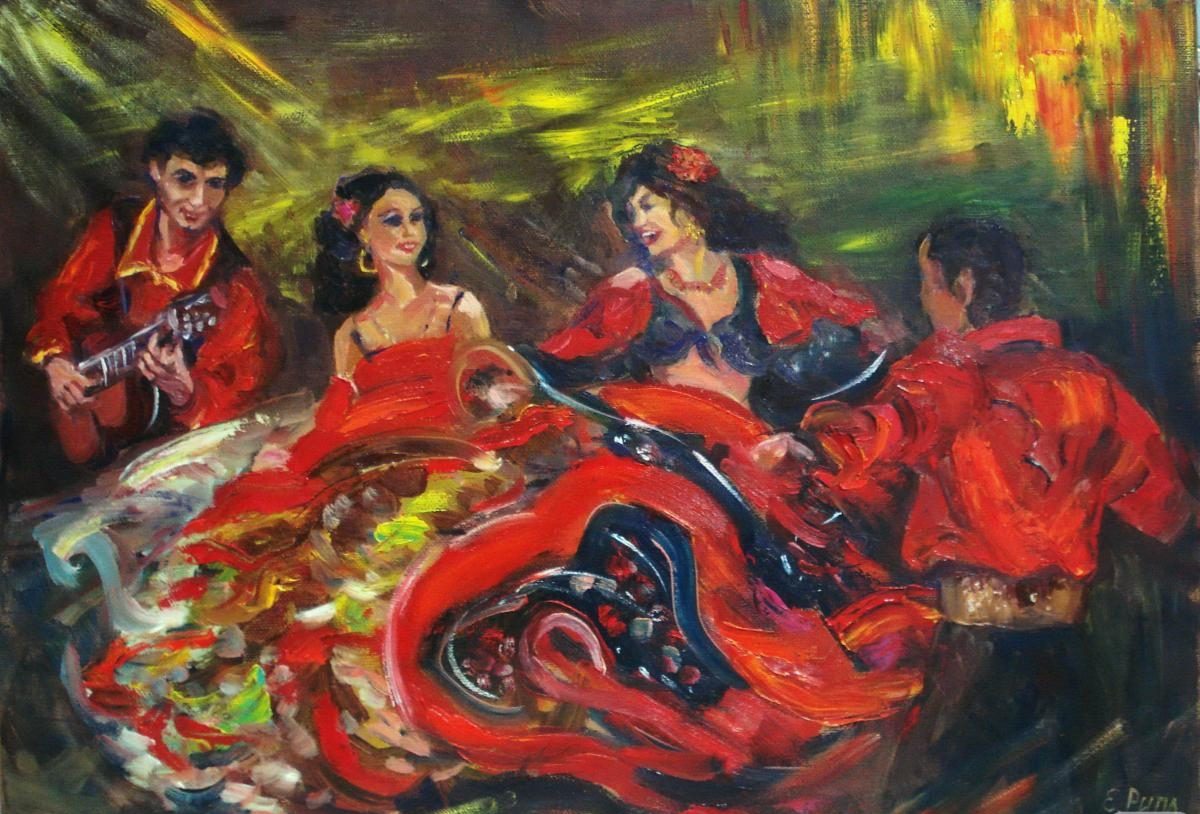
The gypsy style has been part of our repertoire as bellydancers for many years. In general, performances in this style are characterized by a joyful quality, colorful costumes (often including very full skirts, ruffled tops, numerous bright accessories, and flowers in the hair), pelvic and hip movements, skirt work, and the inclusion of acting elements within the choreography (such as miming washing clothes, arguing with someone, or practicing palmistry). Because this style has gained popularity among both artists and audiences, it is relevant to reflect on some of the ideas surrounding it.
The starting point for these reflections in this article is the origin of the term “gypsy” or “gitano.” “Gypsy,” in English, derives from “Egyptian,” just as “gitano,” in Spanish, derives from “egiptano.” In both cases, the etymology of these terms reveals the existence of a hypothesis regarding the origin of this people, a hypothesis that remained influential until relatively recently: it was believed that they originated in Egypt. Some even linked this supposed origin to the twelve tribes of Israel, which were forced to disperse, suggesting that one of those tribes settled in Egypt during the diaspora and gave rise to a people who would later become known as gypsies.
Today, thanks to historical, linguistic, and genetic studies, the hypothesis of an Egyptian origin has been rejected, while the idea that the origin of the Roma lies in Punjab [1] has gained greater support (Matras, 2015; Marsh, 2006). From that region, they are believed to have migrated westward toward Central Asia. This migratory process continued, reaching Europe probably in the 16th century and later the Americas (some accounts suggest that there were already Roma sailors among the crew on Christopher Columbus’s first voyage across the Atlantic Ocean) (Matras, 2015; Fedeli, 2021).
Stereotypes Associated with This Population
At this point, it is important to highlight a significant fact: along with the idea of an Egyptian origin for this people, the term “gypsy” also carried meanings linked to stereotypes associated with this population (Marushiakova & Popov, 2011). These stereotypes could be both negative and positive. Positive stereotypes referred to the nomadic origins of the Roma, associating this way of life with freedom and reflecting a highly romanticized view of the living conditions of those belonging to this culture. They were also sometimes assumed to possess certain magical powers, such as fortune-telling abilities or a particular kind of attractiveness. As for negative stereotypes, Roma men and women were often stigmatized through associations with a wide range of criminal, immoral, or socially disruptive acts: smuggling, human trafficking, child abduction, and deception (Marushiakova & Popov, 2011; Fedeli, 2021).
Because of the persistence of these stereotypes, it is now very common, especially in academic settings, though not exclusively, to use the terms “Roma” or “Romani” when referring to this ethnic group (Matras, 2025; Marsh, 2007). In more colloquial or everyday contexts, however, the term “gypsy” continues to be used, including by members of the community itself, perhaps in a reclaiming sense, given the marginalization and discrimination they have endured over the centuries.
The previous paragraphs may have given the impression that the stigmatization of the Roma belongs to the past. Nothing could be further from reality. The stereotypes mentioned above remain present in the collective imagination. At this point, it should be noted that the dictionary of the Real Academia Española includes, among the meanings of the word “gitano,” the term “trapacero” as a synonym, which has generated considerable controversy and prompted campaigns calling for the removal of that definition. These campaigns, however, have had limited success: although in 2015 the RAE added a usage note warning that the term carries an offensive or discriminatory meaning, the equivalence between the two words remains in the dictionary, demonstrating that the negative stereotypes discussed above are still present.
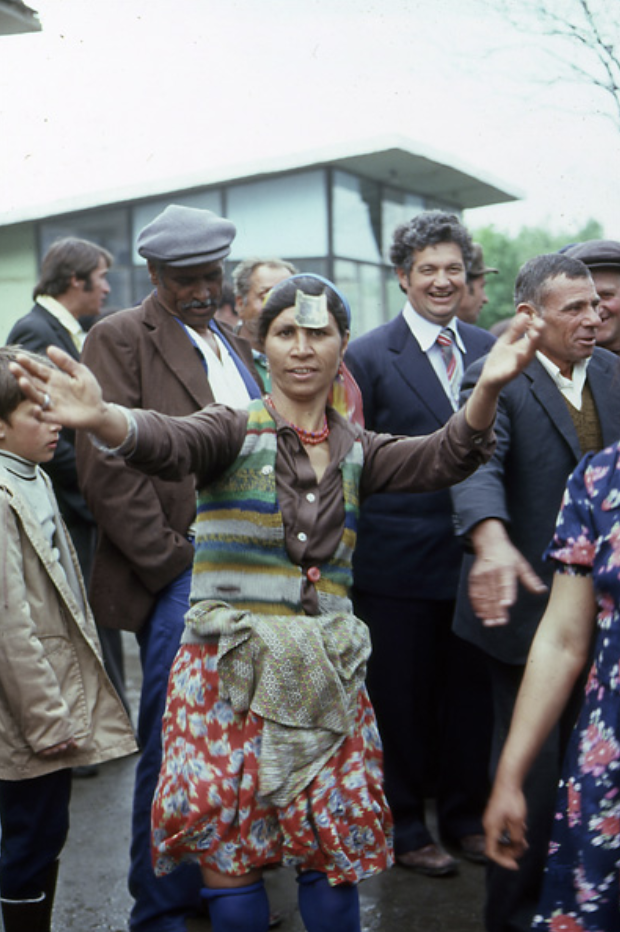
Bailarina recibiendo propinas, Bulgaria, 1984. (Imagen extraída de www.oup.com/us/romaniroutes)
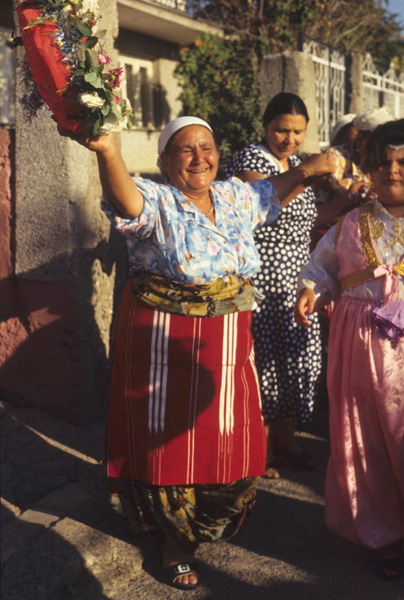
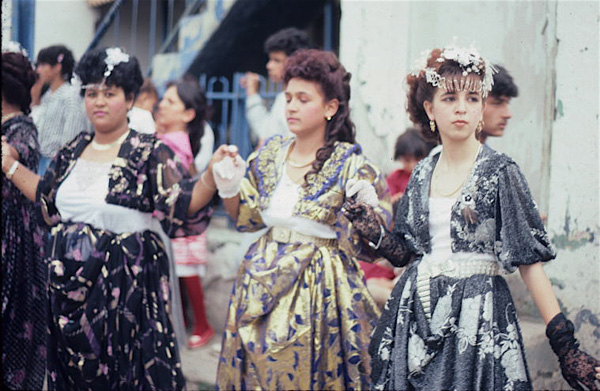
Mujeres bailando en una boda, Šutka, 1990. (Imagen extraída de www.oup.com/us/romaniroutes)
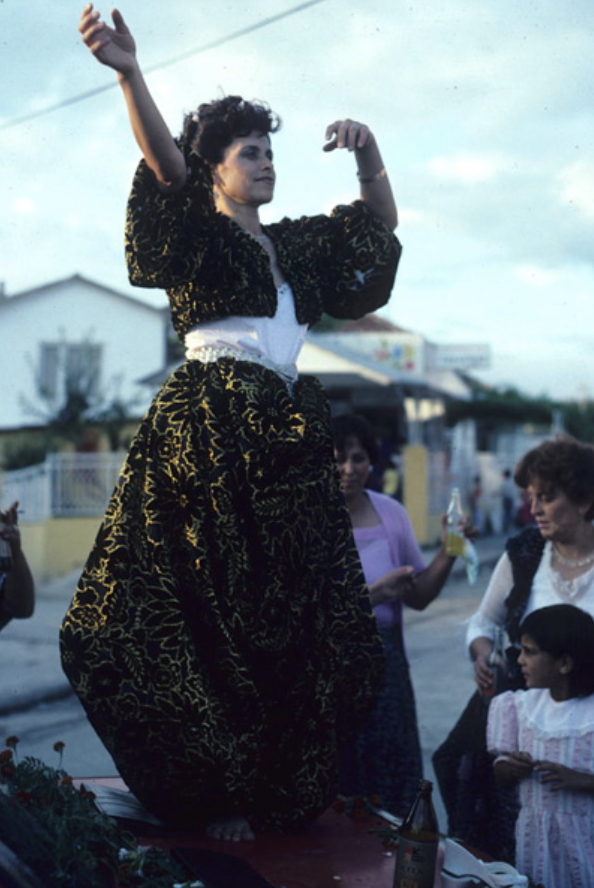
Bailarina en una procesión de circuncisión, Šutka, 1990. (Imagen extraída de www.oup.com/us/romaniroutes)
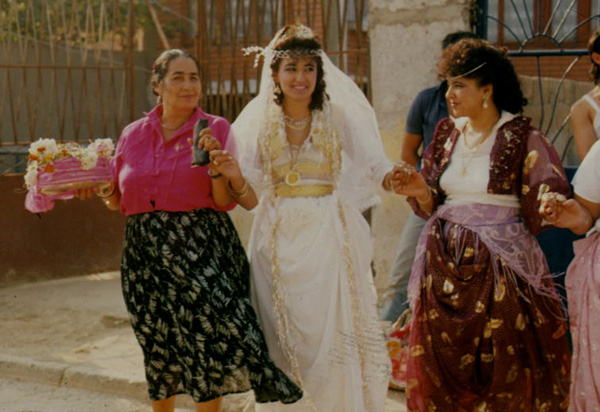
Mujeres bailando en una boda, Šutka, 1990. (Imagen extraída de www.oup.com/us/romaniroutes)
The Term “Gypsy” and Its Relationship to Dance
Following this brief introduction to the term “gypsy” and its implications, an unavoidable question arises: how does all of this relate to dance? I will attempt to answer this in the following paragraphs, while recognizing that reflection on this question is not a closed matter but, fortunately, remains subject to constant revision. It is essential to clarify that I do not intend to assume the role of judge here by determining whether the use of a particular term is correct or incorrect. Rather, my aim is to encourage each reader to question their own artistic production. I mentioned previously that the term “gypsy” carries multiple connotations associated with stereotypes. Put simply, stereotypes create a certain illusion of homogeneity with regard to a group of people: a stereotype about a given group X leads us to think that all those who belong to that group behave, think, and feel in the same way, denying the heterogeneity of experiences, values, customs, and personalities that inevitably exists within it. It is true that people who share a culture will have certain characteristics in common, but it is equally true that diversity exists within every human group. What stereotypes do is render this diversity invisible, thereby making it easier to define alterity by placing those “others” in opposition to “us” (Marushiakova & Popov, 2011; Marsh, 2007).
Earlier, I referred to the migrations of the Romani people. Today, Roma communities exist throughout the world, across countries on all five continents. Each community has characteristics of its own that are not necessarily shared with other Romani communities. Thus, we find different musical styles, different dances, and even different languages [2] (Matras, 2015; Marsh, 2007). In other words, there is no single gypsy or Romani dance style, nor one unique form of dance present across all Roma communities worldwide. Rather, each community has developed different cultural expressions with distinctive characteristics. When we see a “gypsy-style dance” on stage, what we usually see is a choreography created from different technical, choreographic, and aesthetic elements belonging to different Romani communities. For example, we may see skirt work characteristic of Russian Roma dances, pelvic movements typical of Romani dances from Türkiye, hand movements similar to those of Spanish flamenco, and footwork intended to emulate different Balkan dances, together with a costume that likewise combines certain elements taken from different Roma groups with others drawn from the social imaginary surrounding this culture [3]. What we are actually seeing is an individual creation, a fantasy that does not exist in any native context but only within that particular stage creation. It is not a Romani dance, but rather a personal construction produced by combining components drawn from different Romani groups, as well as elements derived from the stereotypes surrounding this culture [4].
Final Reflections
Although it is true that art, at least in the West, values the individual creativity of each artist, it is important to distinguish between creations that are entirely products of that creativity and those that remain more closely connected to dances as practiced in their native contexts. As discussed above, my intention here is not to pass judgment on whether creating and performing a “gypsy-style” choreography is right or wrong [4], but rather to encourage reflection on and critical examination of our own artistic practices, as well as to invite curiosity that may lead us to explore the diversity found among the dances of different Roma groups, which reflect their histories and circumstances [5]. Expanding our knowledge in this area will not only allow us to adopt positions based on a broader range of information, but also to acquire new creative resources with which to expand the possibilities available to us when creating.
Footnotes
[1] The Punjab region is an area encompassing part of northern India and part of eastern Pakistan. Its boundaries are not unequivocally defined. [2] Although Romani communities generally speak a language known as Romani, this language varies among communities in different countries. [3] This reflection is based on the cultural diversity described by Matras (2015) and Marsh (2007), as well as on the discussion of processes of exoticization developed by Marushiakova and Popov (2011). [4] At this point, a clarification is necessary: in recent years, at least in Argentina, there appears to have been a growing awareness of the term “gypsy/gitano” and the stereotypical connotations it carries. As a result, in some cases, those who perform choreographies of this kind sometimes prefer to refer to a “Balkan style.” Although this issue exceeds the scope and length of this article, it is important to bear in mind that, at least in many cases, what seems to occur is the replacement of one stereotype with another, using a term to define a stage style that constitutes a fantasy created from certain ideas about the dances practiced among Romani groups in the Balkan Peninsula, thereby rendering invisible the artistic and cultural diversity of that region (indeed, this could be considered even more “serious” than the use of the term “gypsy,” given that the region has experienced wars that have been justified, at least in part, on the basis of existing ethnic differences). At times, there even appears to be an underlying—and certainly erroneous—assumption that “Balkan” and “Romani” are synonymous. [4] Provided, of course, that we acknowledge and make as clear as possible that such choreography is a fantasy created for a specific event and not a dance belonging to the Roma. [5] This reflection engages particularly with debates on cultural representation developed by Marushiakova and Popov (2011) and Marsh (2007).
References
Bernal, J. (2014). Historias, leyendas y tradiciones gitanas. Editorial Milena Caserola.
Fedeli, L. (2021). Gitanos. Una mirada que muchos no ven. VS Editores.
Marsh, A. (2007). Research and the many representations of Romani identity. Roma Rights Quarterly, (3), 17-30.
Marushiakova, E., & Popov, V. (2011). Between exoticization and marginalization. Current problems of Gypsy studies. BEHEMOTH-A Journal on Civilisation, 4(1), 86-105.
Matras, Y. (2015). The Romani Gypsies. Harvard University Press.
* Automatic translation for english version